Constructive Genetic Code-Table Realization On A Typed Chrysene Carrier
DOI:
https://doi.org/10.68366/ees7wd38Keywords:
constructive realization, frame quotient, atom-conserving graph grammar, codon addressing, affine selection, two-carrier junction, admissible lift, Chrysene FormalismAbstract
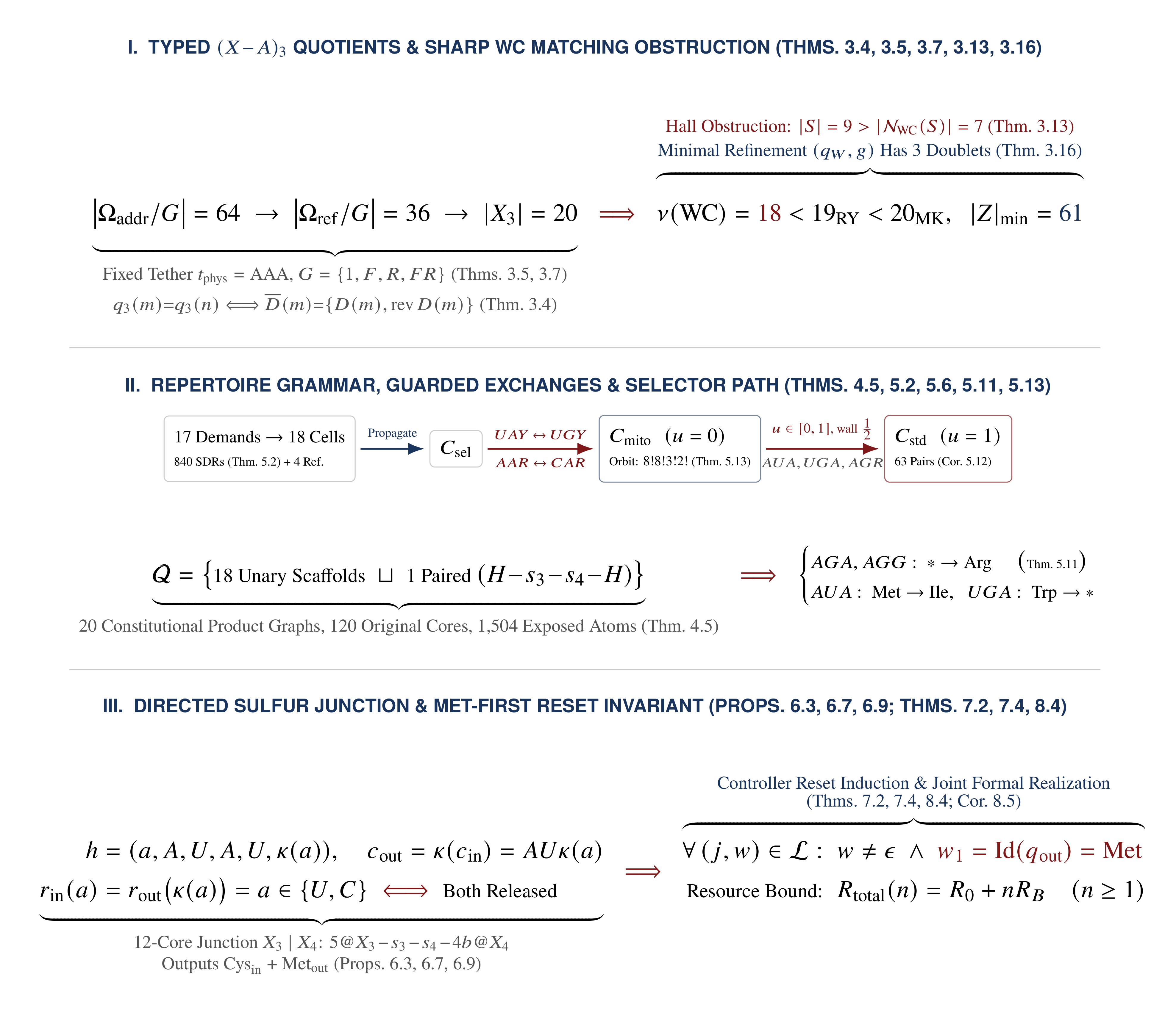
A chrysene-based construction of a genetic-code table requires compatible maps between precursor orientations, retained molecular structures, codon addresses, and readout events. We give a finitely specified constructive realization in which these maps have separate types and can be checked together. A six-core precursor is represented by a three-unit $(X-A)_3$ carrier, with fixed resident adenosines and a separately addressed external coding triplet. The binary frame quotient has twenty classes; explicit reference decorations recover sixty-four addressed states. For the table-conditioned Watson–Crick incidence graph, a nine-class Hall obstruction and an attaining matching establish the sharp matching number eighteen. A declared atom-conserving graph grammar and explicit product constructors supply a formal molecular-graph repertoire; seeded routing, refinement, local address exchanges, and affine selection modules provide finite paths to the vertebrate mitochondrial and standard reference tables. The rules admit alternative tables, so the result is constructive realization rather than unique selection. A corrected two-carrier junction supplies a side-specific release rule and a resource-aware reset invariant for conditional methionine-first segments. The combined construction is nonempty at the formal graph-and-controller level. Molecular feasibility requires a common admissible lift of its graph edits, reservoirs, geometry, and readout, which is stated separately and is not established by the finite certificates. Thus the completed existence claim concerns a precisely specified formal system; the physical interpretation remains conditional.
Downloads
Published
Issue
Section
License
Copyright (c) 2026 Charles D. Schaper, Ph.D.

This work is licensed under a Creative Commons Attribution-NonCommercial-NoDerivatives 4.0 International License.