The Division of the Vessel: The Coded Chain, the Photochrome Brake, and the Genome that Selects Itself
DOI:
https://doi.org/10.68366/s7zef416Keywords:
cell division, photochrome, azobenzene, tethered duplex, division gate, Chrysene FormalismAbstract
This article states the conditions under which a protocell of one tetrasubstituted chrysene family divides.
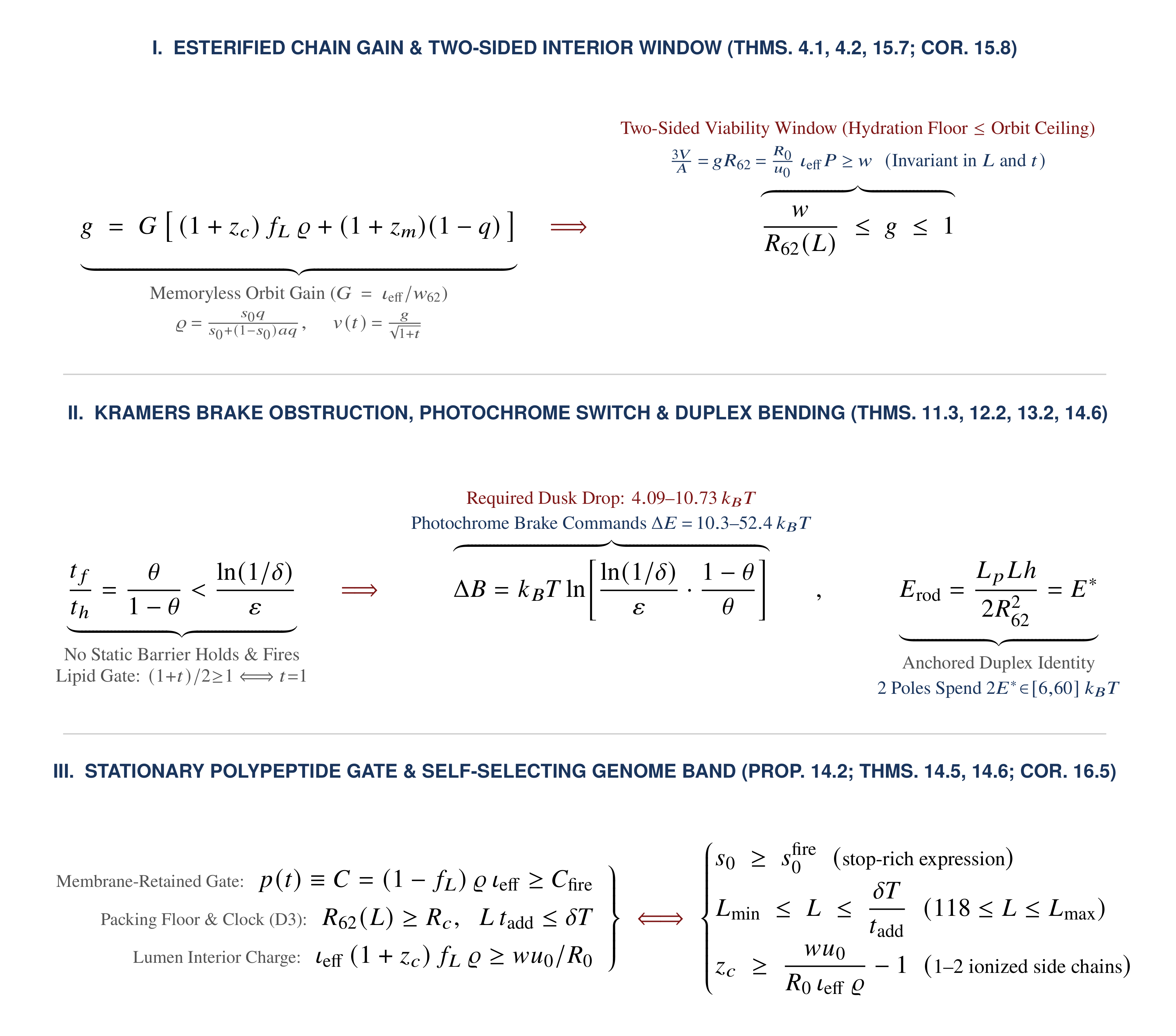
The residue formed at the chrysene is esterified to the 2'- or 3'-hydroxyl of its own tether ribose and linked from there into a chain, so no excision puts a particle into the lumen. A chain reaches the lumen only on release, and only a stop word releases it: there a trapped structure frees the tether phosphate on the chrysene side, and that phosphate, staying bound to its adenosine, hydrolyses the chain transferred onto its hydroxyl. The lumen particles of a period are the released chains and the residues hydrolysed before they joined, and nothing else. This fixes the gain, and with it the vessel's shape: at the stop sets of the observed codes it lies between 0.0588 and 0.5389, so the orbit of the integrated cycle exists with a wide margin.
Division then needs four conditions: the orbit must exist; each daughter must receive enough lipid to close a minimal anchored enclosure, which is shown to confine fission to dusk and to nothing else; replication must have finished; and fission must be withheld until then. The fourth is the one the corpus lacked. Nothing inside the vessel can mark dusk, the shape and every bulk concentration being slaved to the gain; and, treated as escape over a barrier, no barrier of fixed height both holds through the period and fires at dusk, whatever its height and whatever the attempt rate.
The brake is the photochrome, a substituted trans-azobenzene derived from the 6,12-disubstituted chrysene: activated by the forcing it holds fission, and when the forcing ends it relaxes and releases. The timing is then exogenous, and division at dusk, which the corpus has carried as a definition, becomes a consequence. The brake must supply 4.09 to 10.73 $k_B T$; the admissible connector population commands 10.3 to 46.8 $k_B T$. The same population that was short by four to fifty times as a driver of shape is ample as a brake, a brake being priced against a difference and a driver against the whole.
Released at every dusk, the brake would divide every vessel. Two further inputs decide whether a given one does. The first is the extent of membrane-retained polypeptide, which sits at a constant level the genome fixes. The second is the genome: both strands of the duplex are tethered into the bilayer and a daughter needs a whole duplex, so division waits on replication, and it need not be made to, separation requiring the switch in the state that holds fission. The anchors then shape what divides. An anchored duplex pays exactly Article 62's bending tolerance $E^*$ on its own minimal enclosure and less on anything flatter, so two of them, demixed to opposite poles, flatten the poles and leave the curvature between them, with 6 to 60 $k_B T$ to spend on the choice of shape. They fix the axis of the neck and assign one duplex to each daughter; they do not close it, the domains being patches and not hemispheres.
Three conditions then bound the genome: it must express often enough to hold the gate, exceed the packing floor, and be short enough for replication to finish within the forcing. The band between them is non-empty at every rate the corpus carries, and a genome outside it does not divide at all: it grows, loses nothing, and leaves no lineage. The discriminator is the length of the genome and the frequency of its expression, not any rate, and the verdict is inherited.
Downloads
Published
Issue
Section
License
Copyright (c) 2026 Charles D. Schaper, Ph.D.

This work is licensed under a Creative Commons Attribution-NonCommercial-NoDerivatives 4.0 International License.