Carbon Traceable Protocell Construction From Substituted Chrysene Stocks
DOI:
https://doi.org/10.68366/wvna7r05Keywords:
Chrysene Formalism, protocell, carbon ancestry, finite resources, conditional resourcesAbstract
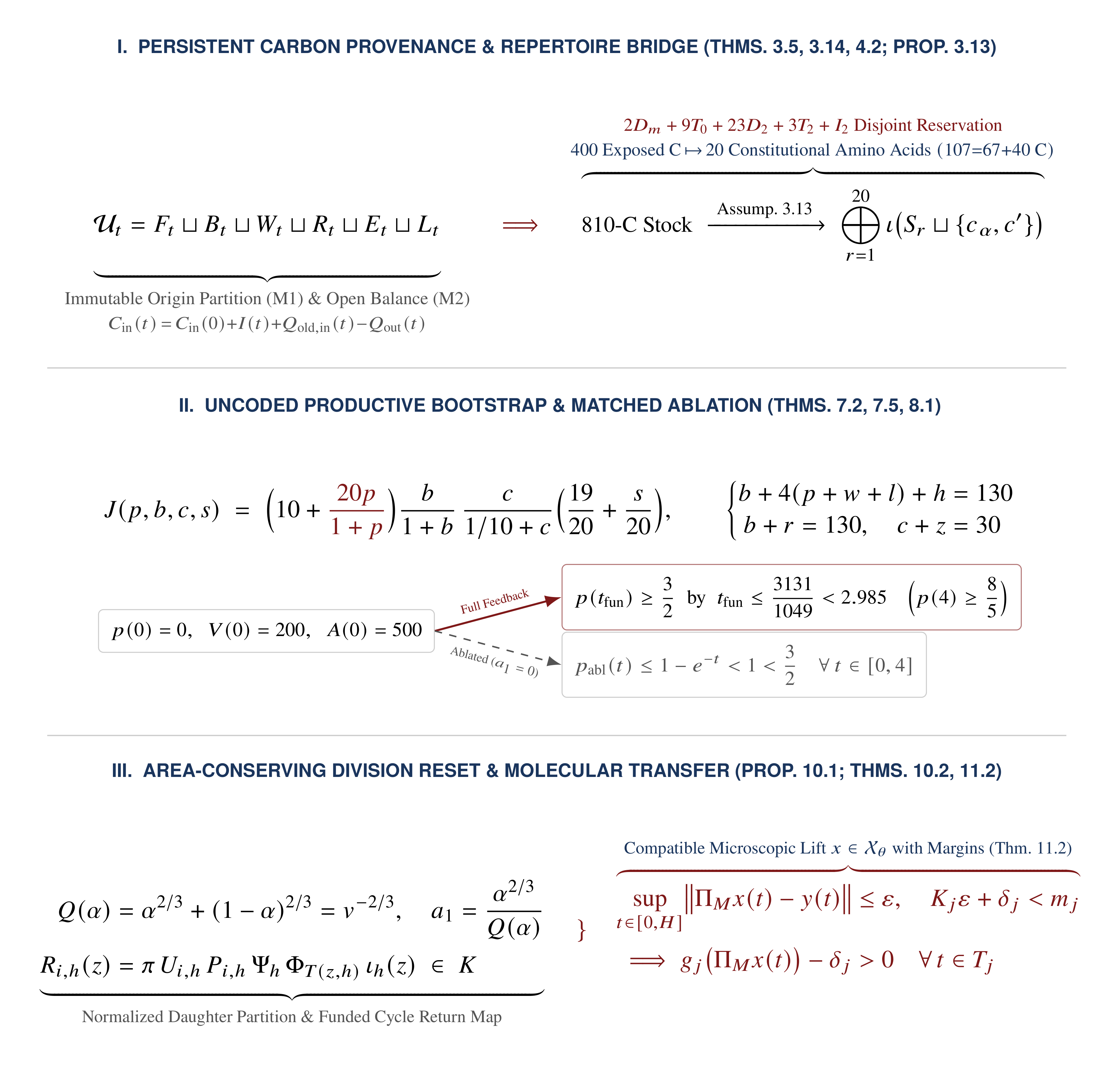
We construct a finite-resource theoretical framework for an externally supplied protocell whose functional carbon is traceable to admitted substituted-chrysene cores and their explicitly constituted organic arms. The initial inventory contains specified 6,12-, 3,6,12-, and 3,6,9,12-substituted stocks, including finite macrocycles, polymers and stacks; a minor 2,5,8,11 pool is optional. Stock manufacture and selection are boundary conditions, rather than tasks performed by the compartment. Persistent atom labels give exact ancestry, open-system balance and no-double-use theorems. Typed preparation and grafting conditions connect the stock boundary to a previously certified constitutional amino-acid grammar without treating open ports as hidden carbon sources. A single explicit uncoded reduced model starts with no peptide, consumes finite donor and release-carrier inventories, produces lumen and retained chains, and reaches a functional retained-product threshold. A matched ablation fails that threshold, establishing a causal productive feedback result under the declared constitutive laws. The same trajectory satisfies positive-invariance, resource, guest-area and idealized water-balance bounds over a finite horizon. Robust operating neighborhoods and resource-aware return-map results distinguish finite operation from repetition. Growth and division are treated through conditional flow–guard–reset statements with normalized daughter-area allocation; physical scission and inheritance are additional requirements. These are constructive mathematical results, including a nonempty assumed-law operating model. They do not assert that its rates, joining chemistry, functional stereochemistry, membrane mechanics and transport have yet been realized by one molecular system. Gene-directed peptide production is an optional extension, not a premise of the base result.
Downloads
Published
Issue
Section
License
Copyright (c) 2026 Charles D. Schaper, Ph.D.

This work is licensed under a Creative Commons Attribution-NonCommercial-NoDerivatives 4.0 International License.