The Transformed Product: Membrane Invariants Measured against the Open Literature, and the Lipid the Patent Route Actually Makes
DOI:
https://doi.org/10.68366/1aey1m29Keywords:
Chrysene Formalism, concordance, membrane invariants, ring opening, phospholipid, bilayer thicknessAbstract
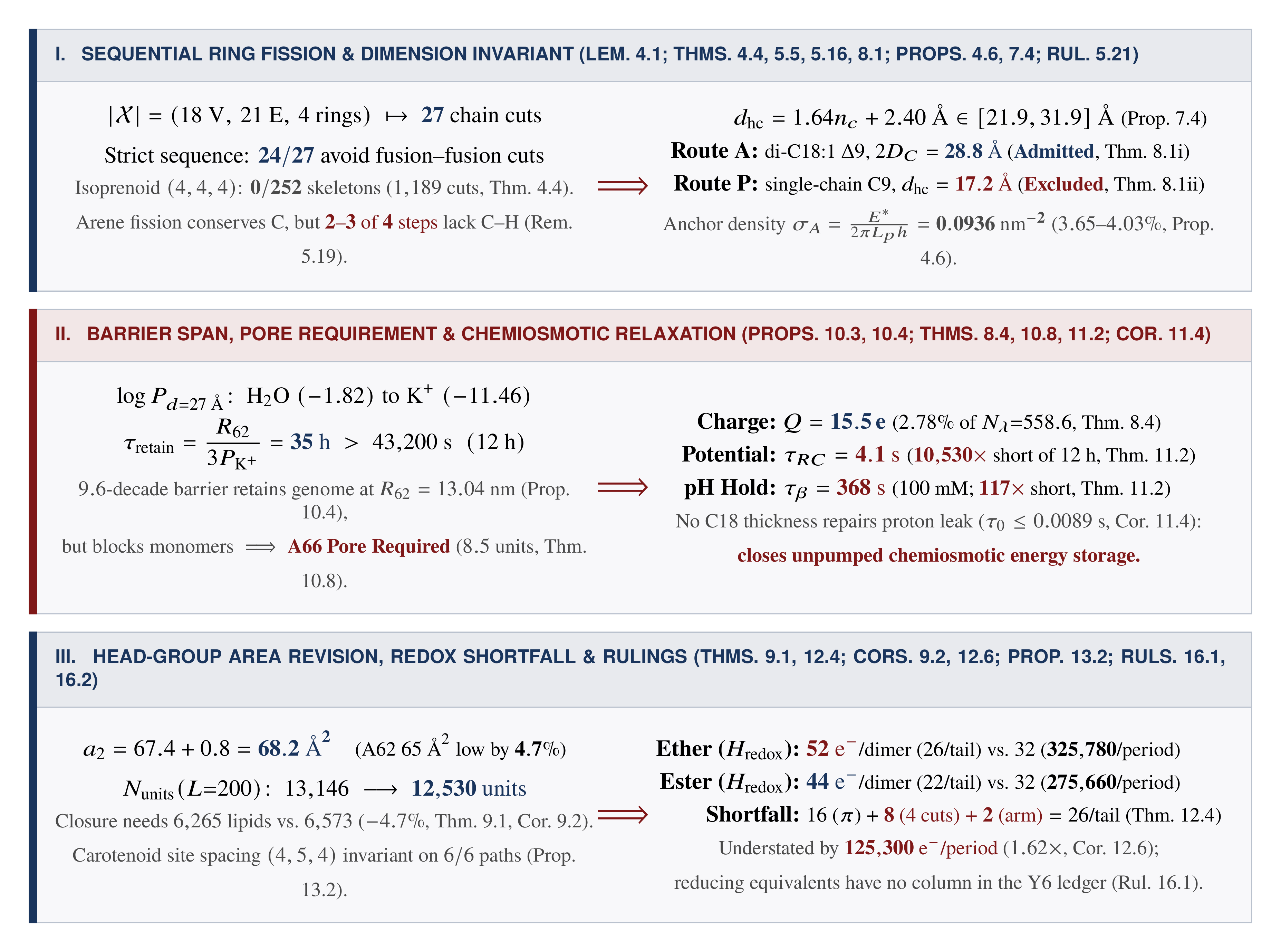
This paper establishes the physical, ledger, and synthetic specifications for a di-O-(octadec-9-enyl) phosphate membrane derived from a cut-set enumeration on the chrysene skeleton. The patent record exhibits this same forty-carbon product at Figure 16(b) and, at column 57, carries the remnant through further cleavages to two single-chain lipids, representing one process across two extents of cleavage. Benchmarking the system against measured literature invariants confirms that the dimension invariant admits the uncleaved di-chain lipid — whose di-C18:1 cis-Δ9 tail yields a hydrocarbon thickness of 2D_C = 28.8 Å within the measured 21.9 to 31.9 Å range — while selecting against the single-chain cleavage product.
Evaluating the material balances refines two ledger parameters: the head-group area is adjusted upward by 4.7 per cent, and transitioning from a count of degrees of unsaturation to a full redox balance establishes a requirement of 52 and 44 reducing equivalents per dimer (compared with 32 under the unsaturation count), identifying an explicit reducing-equivalent input for the material ledger. Because the resulting bilayer retains an enclosed genome while excluding free monomers, the macromolecular pore structure serves as an essential transport conduit for monomer supply. Furthermore, characterizing the electrical relaxation profile shows a capacitive demand of 15.5 elementary charges and a relaxation timescale of 4.1 s relative to the 43,200 s period, defining the operating regime required for chemiosmotic coupling.
Along the synthetic pathway, strictly ordering the ring openings preserves fused-system interiors in 24 of 27 pathways and channels the chemistry through standard carbon-conserving arene ring fission, while identifying 2 to 3 of the 4 cleavage steps at non-hydrogenated carbons that point toward specialized activation conditions such as anaerobic oxidation within a caged construct. Together, these benchmarks define the complete structural, transport, energetic, and synthetic parameters required to realize the chrysene-derived membrane.
Downloads
Published
Issue
Section
License
Copyright (c) 2026 Charles D. Schaper, Ph.D.

This work is licensed under a Creative Commons Attribution-NonCommercial-NoDerivatives 4.0 International License.