A Finite Axiomatic Framework for the Interior Chrysene Lattice and Protocell Organization
DOI:
https://doi.org/10.68366/2pyt7f91Keywords:
Chrysene Formalism, finite chrysene lattice, axiomatic characterization, partial operators, functional realization, genetic addressingAbstract
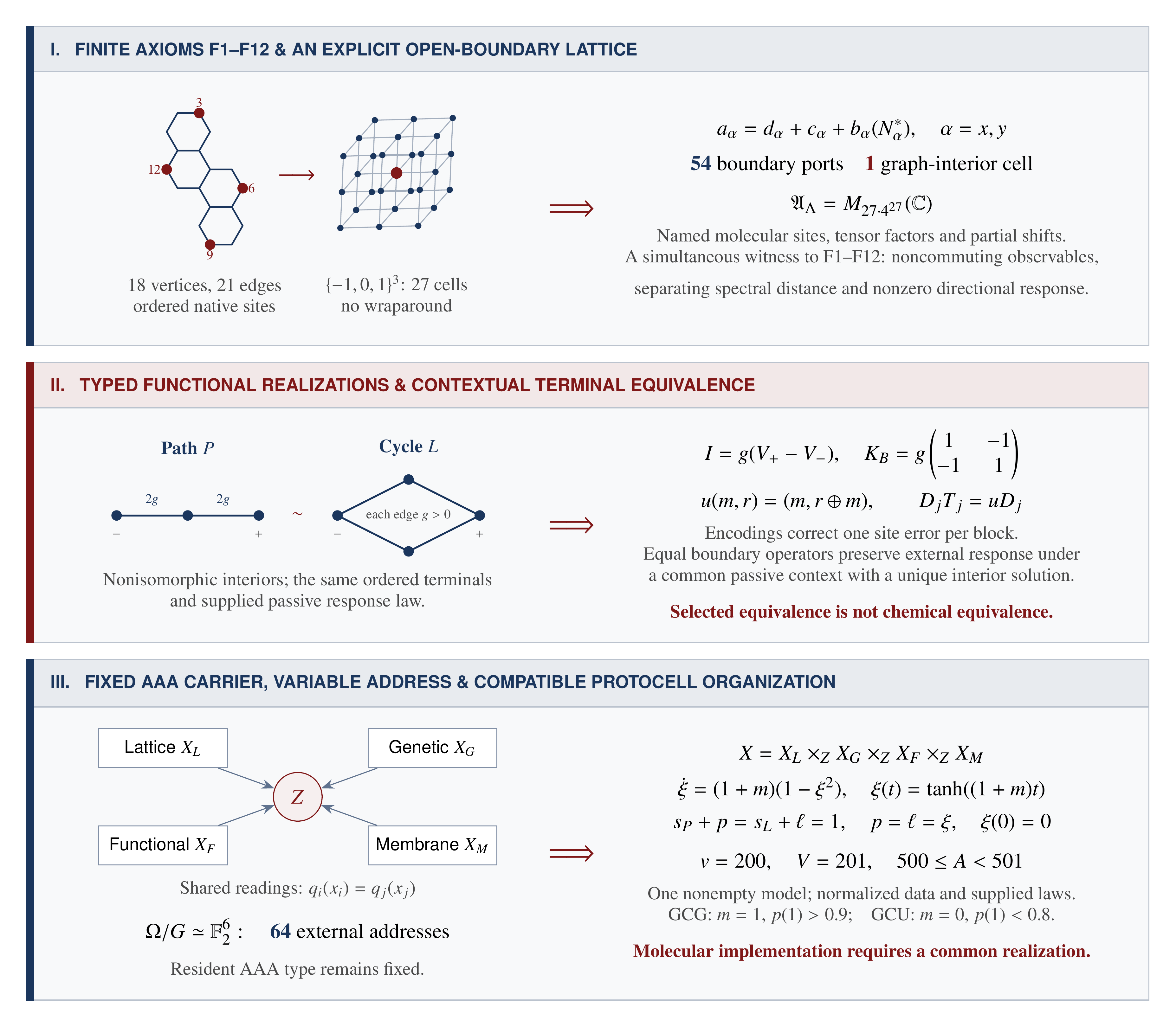
A finite interior chrysene lattice is defined by molecular cells, ordered attachment ports, compatible directional incidence, an explicit boundary, and specified algebraic and dynamical enrichments. We formulate finite counterparts F1–F12 of the twelve-axiom chrysene framework and prove a recognition theorem: a finite directional graph is an induced lattice region precisely when its edge increments integrate to distinct lattice coordinates and its nearest-neighbor incidence is complete. A 3 × 3 × 3 construction gives a nonempty model with an interior cell and nontrivial plaquettes. Partial translations generate a finite matrix algebra; its tensor extension admits an explicit standard form and a separating spectral seminorm. A distinct edge representation identifies a geometric spectral distance with weighted graph distance. We then define functional realizations, typed partial operations and several inequivalent notions of equivalence. Nonisomorphic path and cycle components realize the same ordered-port control and terminal response, and this response equivalence is preserved under passive interconnection. A fixed AAA carrier supplies reference-invariant external addressing, while a fiber-product construction coordinates genetic, functional and membrane states. A concrete finite-stock model proves compatibility and viability on a specified interval. Theorems about these finite structures require no assertion that geometry alone determines chemistry, chirality, quantum coherence or biological function. Molecular implementations are characterized by an additional common-realization condition.
Downloads
Published
Issue
Section
License
Copyright (c) 2026 Charles D. Schaper, Ph.D.

This work is licensed under a Creative Commons Attribution-NonCommercial-NoDerivatives 4.0 International License.