The Chrysene Formalism as Candidate Mathematics and Candidate Biogenesis: A Quantitative and Categorical Survey of Volume 1, Number 2
DOI:
https://doi.org/10.68366/njjxxs08Keywords:
Chrysene Formalism, genetic code, registry classes, frame group, axiomatic foundations, biogenesis, orthogonal reviewAbstract
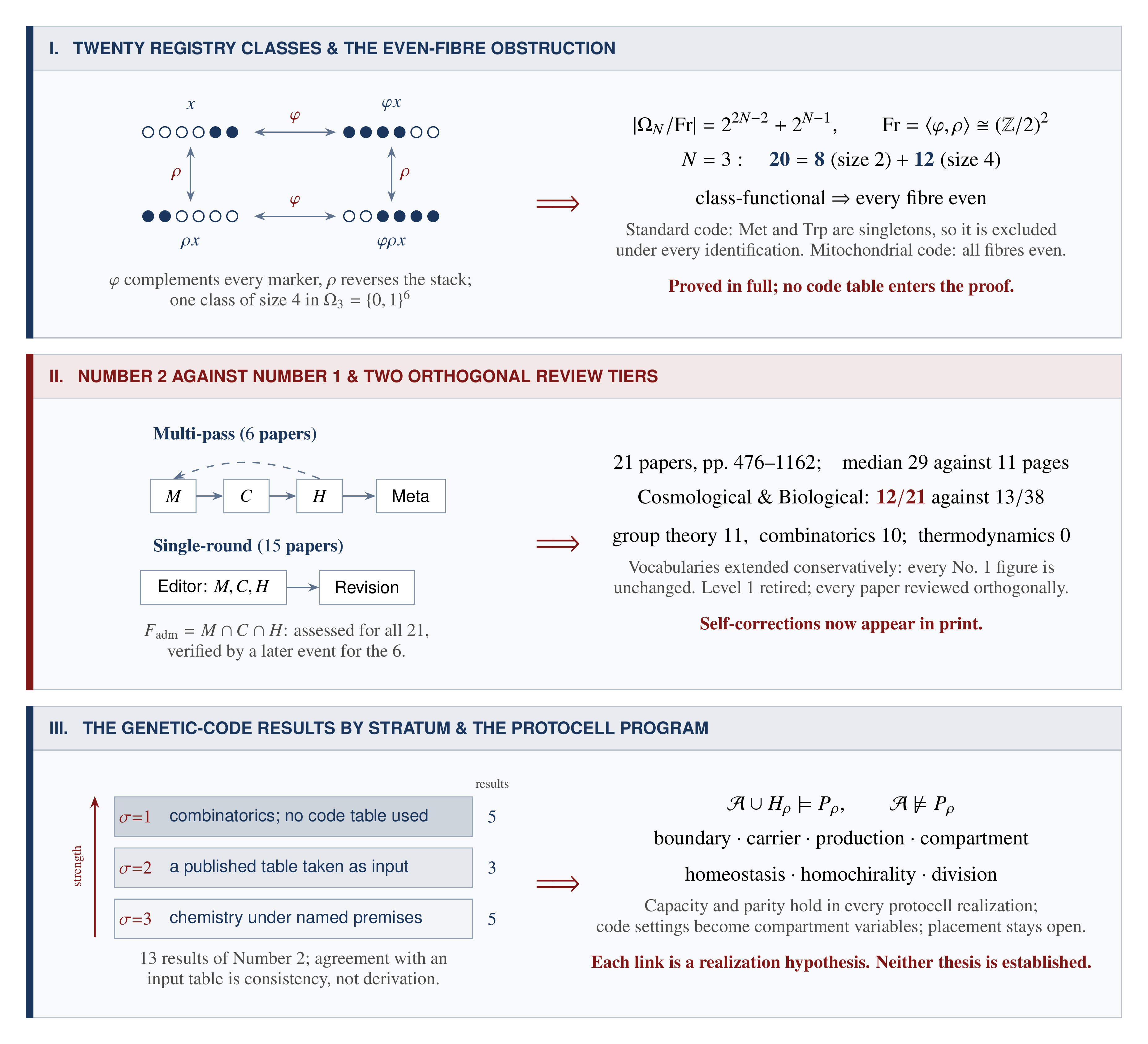
This paper is the editorial introduction to Volume 1, Number 3 of the Annals of the Chrysene Formalism and a retrospective, categorical, and quantitative survey of the twenty-one papers of Volume 1, Number 2. Number 2 differs from Number 1 in three measurable respects: its subject matter concentrates on the combinatorial origin of the genetic code; its mean paper length is 32.7 pages against 12.5; and every paper was reviewed under the orthogonal criteria of mathematical validity, framework concordance, and chemical admissibility, with no paper under the undifferentiated Level 1 protocol. Six papers — those carrying the critical formalism and the critical genetic-code results — received multi-pass review; fifteen received a single orthogonal round of editor review and revision. We formalize both tiers, state precisely what each certifies, and record the consequence-weighted rule by which papers were allocated between them. The corpus is classified by the categories, basis of argument, and formal techniques of the predecessor survey, extended conservatively where Number 2 required it. The genetic-code results are stratified into combinatorial theorems that use no code table, constructions that take a published table as input, and chemical mechanisms stated under named premises; for the first stratum we give complete proofs of the registry-class count and of the even-fibre parity obstruction. We argue that Number 2 advances the pure-mathematics thesis through new proved results and printed self-corrections, and sharpens the biogenesis thesis by replacing the Identification Hypothesis, within the code sub-series, by narrower premises that terminate in specific measurements. Neither thesis is established. We close by setting the program of Number 3: the protocell, its upstream material sources, and the representation of the formalism's mathematics in protocell components, each such representation stated as a realization hypothesis rather than as an identity.
Downloads
Published
Issue
Section
License
Copyright (c) 2026 Charles D. Schaper, Ph.D.

This work is licensed under a Creative Commons Attribution-NonCommercial-NoDerivatives 4.0 International License.