The Source Duality: Endogenous and Exogenous Preparation of the Substituted-Chrysene Stock, Mixed Arm Words, and the Persistence Semigroup

Authors

  • Charles D. Schaper, Ph.D.

DOI:

https://doi.org/10.68366/2tp1jv23

Keywords:

Chrysene Formalism, source duality, persistence semigroup, spectral distance, mixed-arm words

Abstract

In a source-supported product-column model, endogenous self-separation and exogenous placement supply the same substituted-chrysene configurations but control different aspects of their specification. We formulate a parameterized source measure separating chemical species, directional code, and contact registry. On the all-$e$ locus without adjacent initiator pairs, the selection cost splits additively and its kinetic and registry cross-sensitivities vanish; a blind column of length $l$ retains a registry cost of $l-1$ bits. We classify mixed arm words under partial arm conversion and show that homotypic $D(eh)$ contacts can be orientation-selective, whereas accepted $D(eh)$–$T(eeee)$ contacts and $I(eee)$–$D(eh)$ cap contacts remain blind. For the $3\times3\times6$ interior lattice, all 45 stacking contacts are blind before lateral closure, while the fully bridged central column has no free terminals and remains blind under the stated contact model. We distinguish these 45 vertical relations from 53 agreements when eight inter-column relations are added. Coupled bulk-return and flip dynamics identify separate persistence requirements and conditional loss of frame-dependent readout after cap conversion. Finally, a flip-symmetrized structural-state embedding is injective on the contact description and, under an explicit commutator hypothesis, gives the spectral-distance lower bound $(l-1)/(2\gamma_z)$. The conclusions are finite combinatorial or conditional mathematical results; molecular interpretations and experimental targets are kept separate.
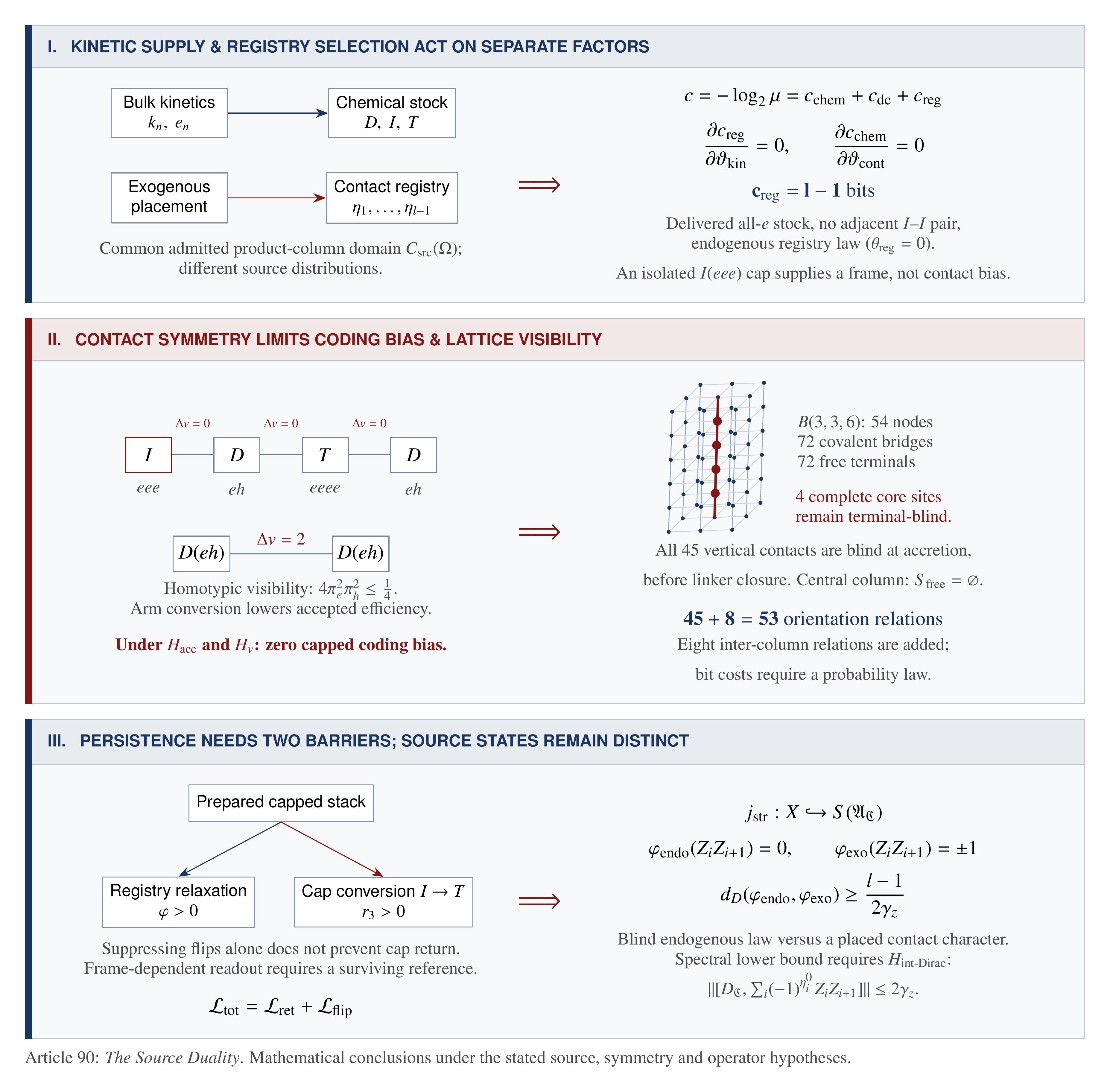
Three-tier graphical abstract for Article 90, The Source Duality, in the journal's navy and burgundy style.  Tier I separates bulk kinetics, which controls chemical stock D, I and T, from exogenous placement, which prescribes contact registry. The comparison is restricted to the common declared D/I/T product-column source domain, with h/e arm words, and compares different distributions on that domain. Selection cost is the sum of chemical, directional-code and registry contributions. On the delivered all-e locus without adjacent I-I pairs, the kinetic and contact cross-sensitivities vanish, and the endogenous registry cost of a length-l column is l minus 1 bits. An isolated I(eee) cap supplies a reference frame without biasing its contact.  Tier II contrasts a capped I(eee)-D(eh)-T(eeee)-D(eh) chain, whose displayed contacts each have coincidence contrast Δv = 0, with a homotypic D(eh)-D(eh) contact with Δv = 2. The unconditioned homotypic visibility frequency is 4π_e²π_h², at most one quarter; arm conversion lowers accepted arm efficiency. Under the acceptance and contact-coincidence hypotheses, the capped alternating coding chain gains no orientation bias. Beside it, a 3 by 3 by 6 lattice contains 54 nodes, 72 covalent bridges and 72 free terminals. Four complete central sites are highlighted. All 45 vertical contacts are blind before linker closure, and the central column has no free terminals after closure. Adding eight inter-column relations gives 53 orientation relations; interpreting this count as bits requires a probability law.  Tier III shows two changes to a prepared capped stack: positive flip rate relaxes registry, and positive cap-return rate permits conversion of I to T. Suppressing flips does not prevent cap return; frame-dependent readout requires a surviving reference. A structural-state embedding contrasts zero endogenous contact expectation on a blind column with placed expectations of plus or minus one. The spectral distance is at least (l minus 1)/(2γ_z), conditional on the displayed commutator bound.

Published

2026-11-06

Issue

Section

Original Research (Research Articles)

How to Cite

[1]
C. Schaper, “The Source Duality: Endogenous and Exogenous Preparation of the Substituted-Chrysene Stock, Mixed Arm Words, and the Persistence Semigroup”, ACF, vol. 1, no. 4, pp. 1823–1835, Nov. 2026, doi: 10.68366/2tp1jv23.