Emergent Assembly Chirality and Flip Kinematics: Euclidean Stabilizers of the Frame Classes, Enantiotopic Faces of the C2h Core, and Initiator Capping of the Interior Lattice
DOI:
https://doi.org/10.68366/r2wxe526Keywords:
Chrysene Formalism, assembly chirality, Euclidean stabilizer, registry reversal, conformational bias, initiator cappingAbstract
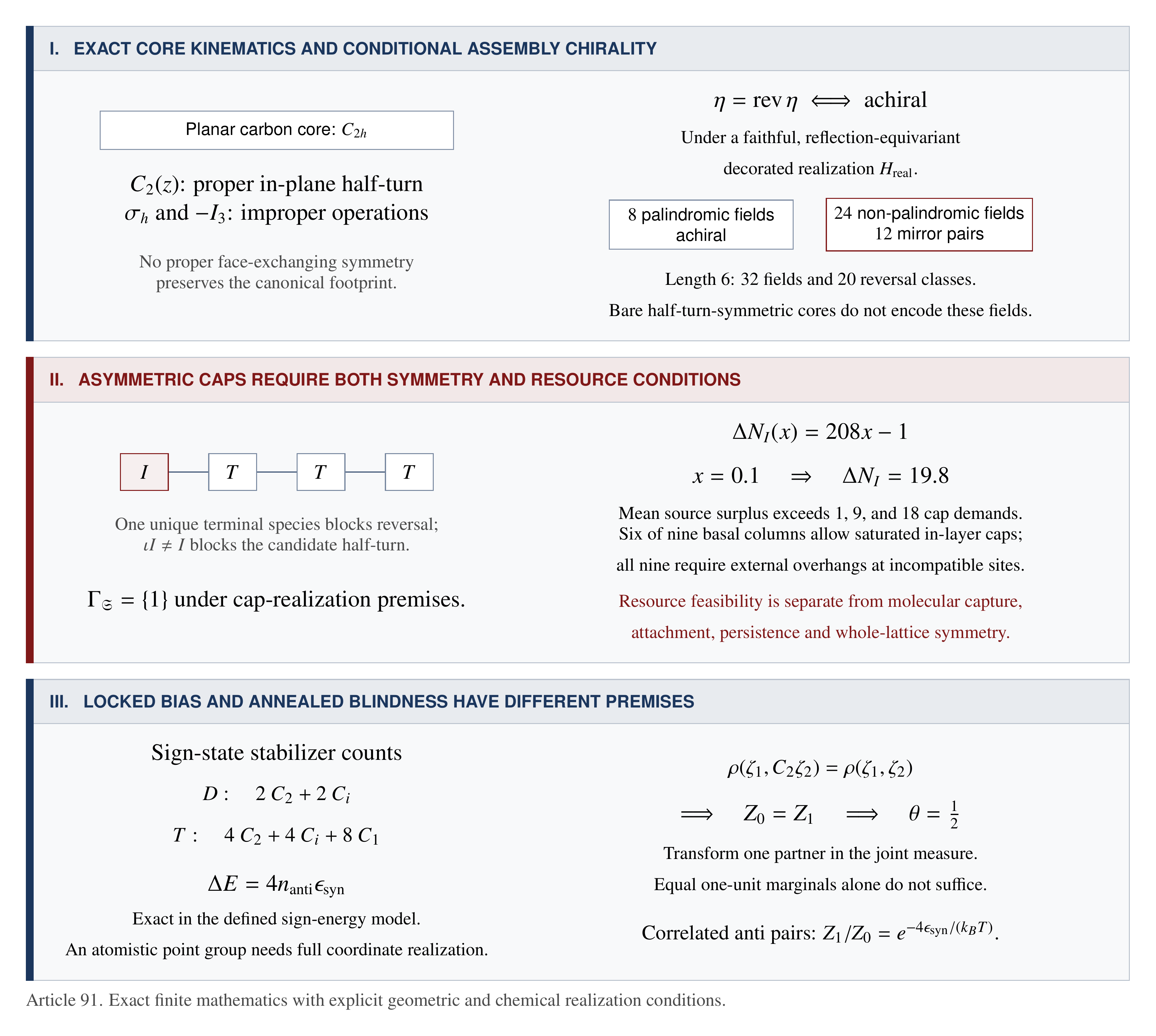
The canonical planar chrysene carbon framework has point group $C_{2h}$ and no reflection symmetry within its plane. We establish that its locant involution is induced by the in-plane half-turn $C_2(z)$; no proper face-exchanging rotation preserves the same carbon footprint. We then separate the finite registry classification from its geometric realization. Under an explicit faithful, reflection-equivariant decorated-realization hypothesis, a species-symmetric stack is achiral precisely when its alignment field is palindromic. At length $l=6$, the $32$ fields comprise $8$ achiral fields and $24$ chiral fields forming $12$ mirror pairs. Uniform endogenous draws are racemic at the ensemble level, whereas ideal placement can select one member of a pair. A unique asymmetric terminal cap removes the candidate nonidentity stabilizers under the stated layer-preservation and realization conditions. The imported matched-source model yields an initiator surplus of $19.8$ units per period, exceeding the separate resource demands of $1$, $9$, or $18$ caps; saturated in-layer placement is available only on the compatible boundary columns, while other columns require external overhangs. Finally, a finite arm-sign model partitions the $D$ and $T$ states by stabilizer and gives an explicit orientation bias for fixed, identical anti or mixed states. Thermal restoration of blindness follows from invariance of the joint conformational measure under a single-partner half-turn. A correlated anti-state counterexample shows why symmetric one-unit marginals alone do not suffice. Exact enumeration, new verification code, and finite Lean certificates support the algebraic statements; the geometric and chemical interpretation is stated through explicit realization assumptions.
Downloads
Published
Issue
Section
License
Copyright (c) 2026 Charles D. Schaper, Ph.D.

This work is licensed under a Creative Commons Attribution-NonCommercial-NoDerivatives 4.0 International License.