Quantum Behavior of Substituted-Chrysene Molecular Assemblies: Bipartite Schur-Complement Transfer Anisotropy, Quadratic-to-Linear Stark Switching Across (D, I, T), and Registry-Gated Ballistic Transport
DOI:
https://doi.org/10.68366/yk7r1k56Keywords:
Chrysene Formalism, quantum molecular electronics, Schur-complement transfer, directional anisotropy, ballistic transport, Stark TuningAbstract
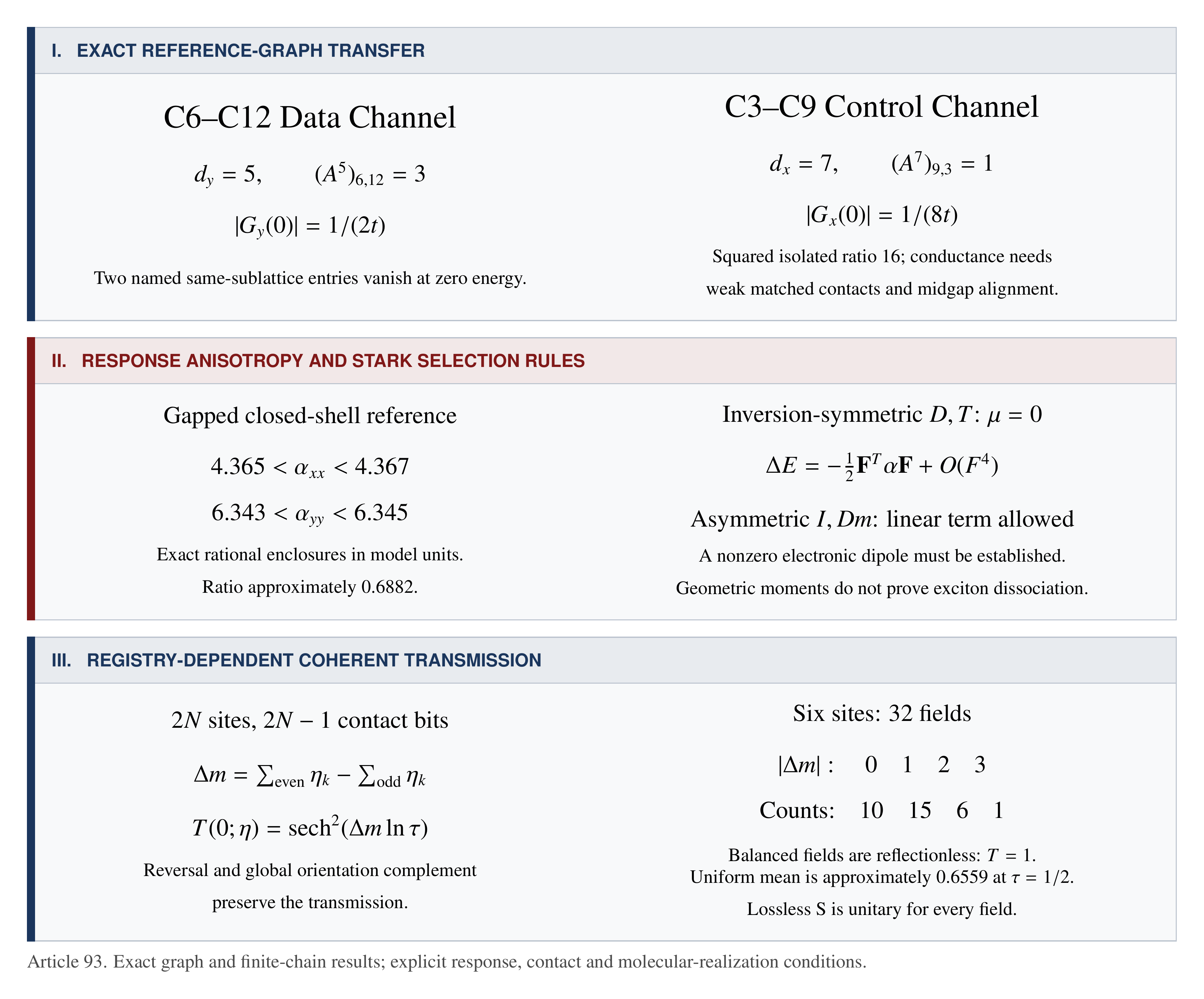
A uniform-hopping model on the 18-vertex chrysene graph connects directional transfer, electric response and registry-dependent transport. The C6--C12 and C3--C9 terminal pairs have first nonzero Schur-complement moments at orders five and seven, respectively, proving inequivalence of their scalar transfer functions. At the gap center their isolated Green-function magnitudes are $1/(2t)$ and $1/(8t)$, giving an exact squared-amplitude ratio of 16; its conductance interpretation requires matched weak contacts and appropriate level alignment. Chiral sublattice symmetry forces two named same-sublattice resolvent entries to vanish at this energy. For the gapped closed-shell reference Hamiltonian, corrected response calculations establish unequal diagonal polarizabilities, with $\alpha_{xx}^{(0)}/\alpha_{yy}^{(0)}\simeq0.6882$. Inversion-symmetric site potentials on $D=\{6,12\}$ and $T=\{3,6,9,12\}$ force zero permanent model dipole and an even Stark energy branch. The asymmetric $I=\{3,6,12\}$ and mixed-arm $Dm$ cases permit a linear term when their actual electronic dipole is nonzero; geometric locant moments are treated separately. Finally, a coherent $2N$-site chain with $2N-1$ registry bits and matched leads has exact zero-energy transmission $T(0;\eta)=\operatorname{sech}^2(\Delta m(\eta)\ln\tau)$. Reversal and global orientation complement preserve this transmission. At six sites, the 32 fields split into counts $(10,15,6,1)$ by $|\Delta m|$, while the uniform-ensemble mean scales as $\Theta(N^{-1/2})$ for fixed $0<\tau<1$. The results supply explicit operator realizations and identify the additional molecular and experimental conditions needed to apply them.
Downloads
Published
Issue
Section
License
Copyright (c) 2026 Charles D. Schaper, Ph.D.

This work is licensed under a Creative Commons Attribution-NonCommercial-NoDerivatives 4.0 International License.