Topological Fault Tolerance, Fiedler Routability, and Partially Bridged Percolation of the Interior Chrysene Lattice
DOI:
https://doi.org/10.68366/w2k3am41Keywords:
Chrysene Formalism, interior chrysene lattice, homological scission, Fiedler algebraic connectivity, directional attachment geometryAbstract
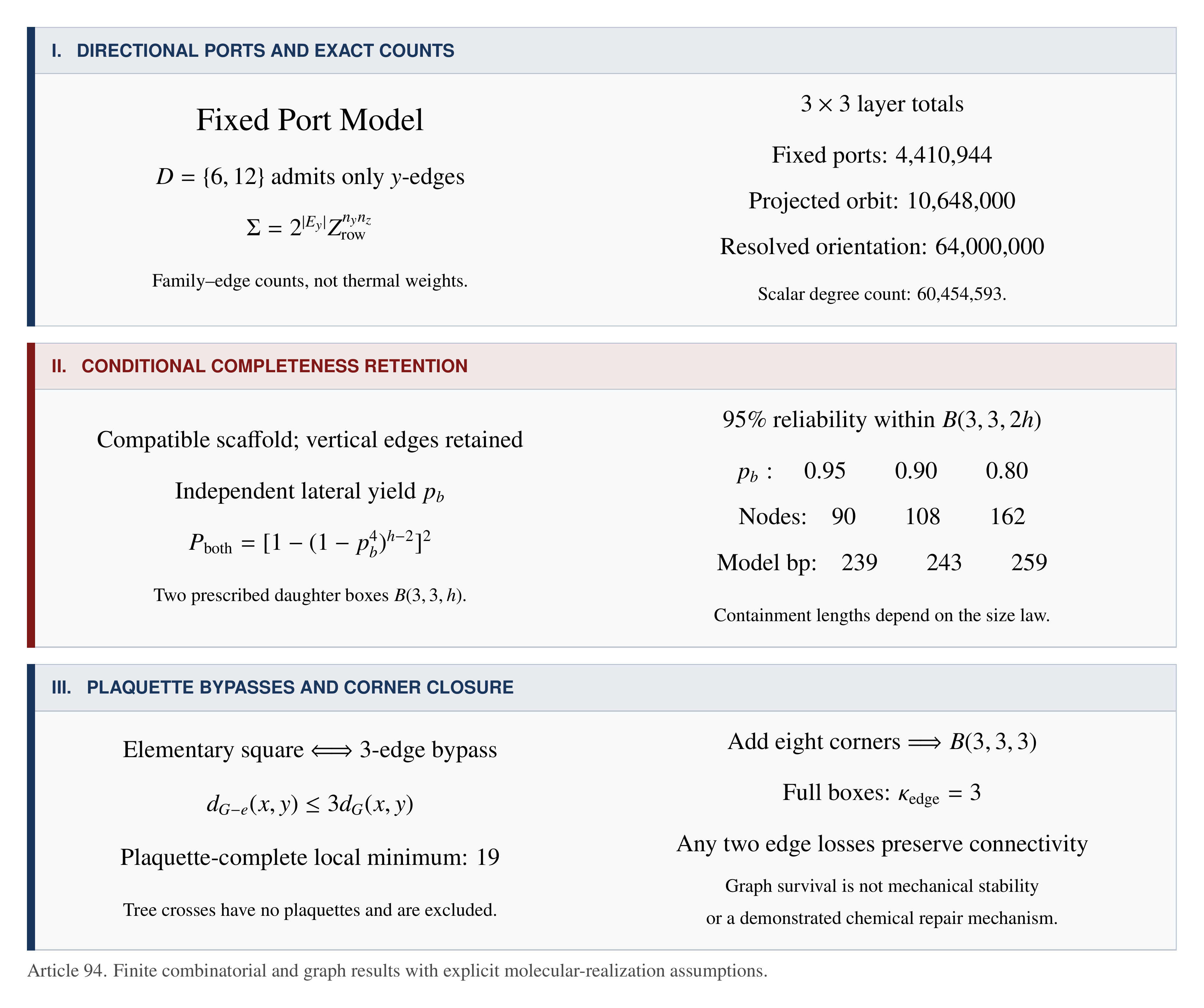
We study directional port compatibility, finite bridge reliability and graph-theoretic fault tolerance in the interior chrysene lattice. In the fixed-port model, the disubstituted family $D=\{6,12\}$ supports only the $y$-axis, while the admitted trisubstituted and tetrasubstituted families produce exact bridge--family counts. On a $3\times3$ layer, the fixed-port and orientation-admissible family sums are $4{,}410{,}944$ and $10{,}648{,}000$, compared with the corrected scalar-degree sum $60{,}454{,}593$. Under independent lateral-edge installation on a compatible scaffold with intact vertical contacts, retention of at least one complete site in each prescribed daughter half has probability $[1-(1-p_b^4)^{h-2}]^2$. Within the $3\times3\times2h$ box family, the $95\%$ retention thresholds are $90$, $108$ and $162$ nodes at $p_b=0.95$, $0.90$ and $0.80$; the stated containment model gives corresponding length parameters $239$, $243$ and $259$ bp, with $233$ bp at saturation. An edge lies on an elementary plaquette exactly when its endpoints admit a three-edge bypass. This yields a unit-metric distortion bound and preserves connectivity after deletion. Plaquette completeness directly excludes the seven- and fourteen-vertex crosses but has a sharp $19$-vertex local minimum; the $27$-vertex box requires an additional corner-closure hypothesis. We give the cycle ranks, boundary-map ranks, Laplacian gaps and single- and double-edge resilience of the two benchmark boxes, separating graph connectivity from mechanical stability and chemical repair. Reproducible verification and finite Lean certificates accompany the conditional molecular interpretation.
Downloads
Published
Issue
Section
License
Copyright (c) 2026 Charles D. Schaper, Ph.D.

This work is licensed under a Creative Commons Attribution-NonCommercial-NoDerivatives 4.0 International License.