K-Theory of the Sequence Algebra, Spectral Dimension Three, and Path-Calibrated Spectral Metrics
DOI:
https://doi.org/10.68366/ns5sbw92Keywords:
Chrysene Formalism, Operator K-Theory, Pimsner–Voiculescu exact sequence, UHF algebra, spectral distance, path-metric calibrationAbstract
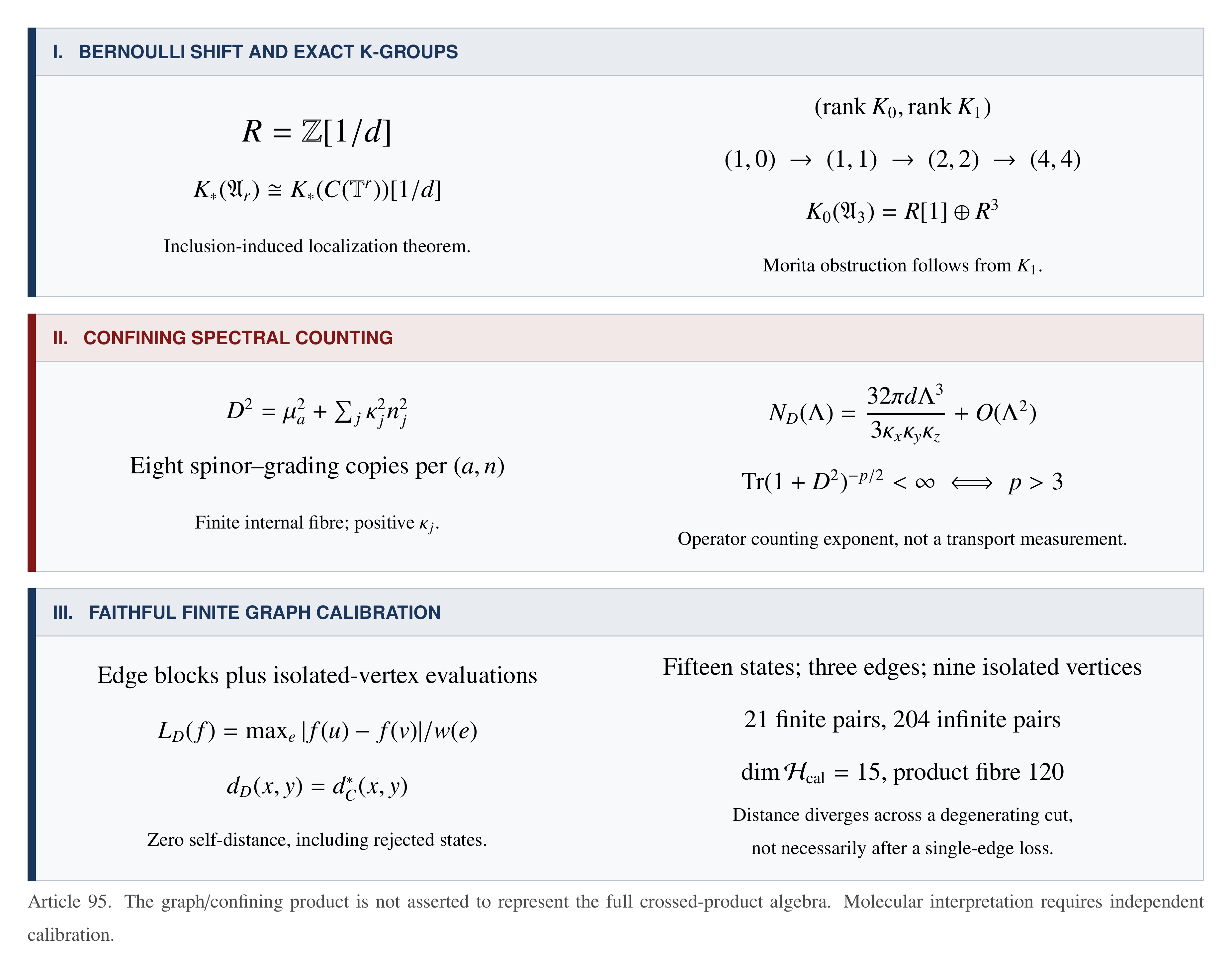
We study three operator-algebraic constructions associated with the sequence framework: crossed-product $K$-theory, a confining spectral operator, and a calibrated finite-graph metric. For the quasi-local UHF algebra of type $d^\infty$, the product trace proves that lattice shifts act trivially on $K_0\cong\mathbb Z[1/d]$. The first crossed product has $K_0\cong K_1\cong\mathbb Z[1/d]$. For all three crossed-product stages, the inclusion-induced localization theorem for noncommutative Bernoulli shifts yields the exterior-power groups, trace decomposition and unconditional Morita obstructions. This replaces an insufficient elementary Pimsner--Voiculescu induction with an explicit analytic theorem dependency. Independently, a finite-fibre graded confining operator satisfies $N_D(\Lambda)=32\pi d\Lambda^3/(3\kappa_x\kappa_y\kappa_z)+O(\Lambda^2)$ and has spectral dimension three. For every finite weighted graph, an edge representation augmented by isolated-vertex blocks is faithful and its spectral distance equals the extended shortest-path distance. The fifteen-state source example has 21 finite and 204 infinite ordered-pair distances. A graded product retains both this finite-graph metric and the confining counting exponent. Cut-set degeneration, rather than deletion of an arbitrary single edge, gives a sufficient condition for distance divergence. The mathematical constructions are separated from molecular realization, and companion verification and Lean dossiers certify finite consequences within their stated scope.
Downloads
Published
Issue
Section
License
Copyright (c) 2026 Charles D. Schaper, Ph.D.

This work is licensed under a Creative Commons Attribution-NonCommercial-NoDerivatives 4.0 International License.