Quantum Information Dynamics of the Source and the Placed Source: Lindblad Dynamical Scission, Von Neumann Entropy Production, and Landauer-Bounded Quantum-Classical Transduction
DOI:
https://doi.org/10.68366/a4q86h84Keywords:
Chrysene Formalism, quantum information dynamics, quantum dynamical scission, von Neumann entropy, Landauer erasure bound, decoherence-free subsystemAbstract
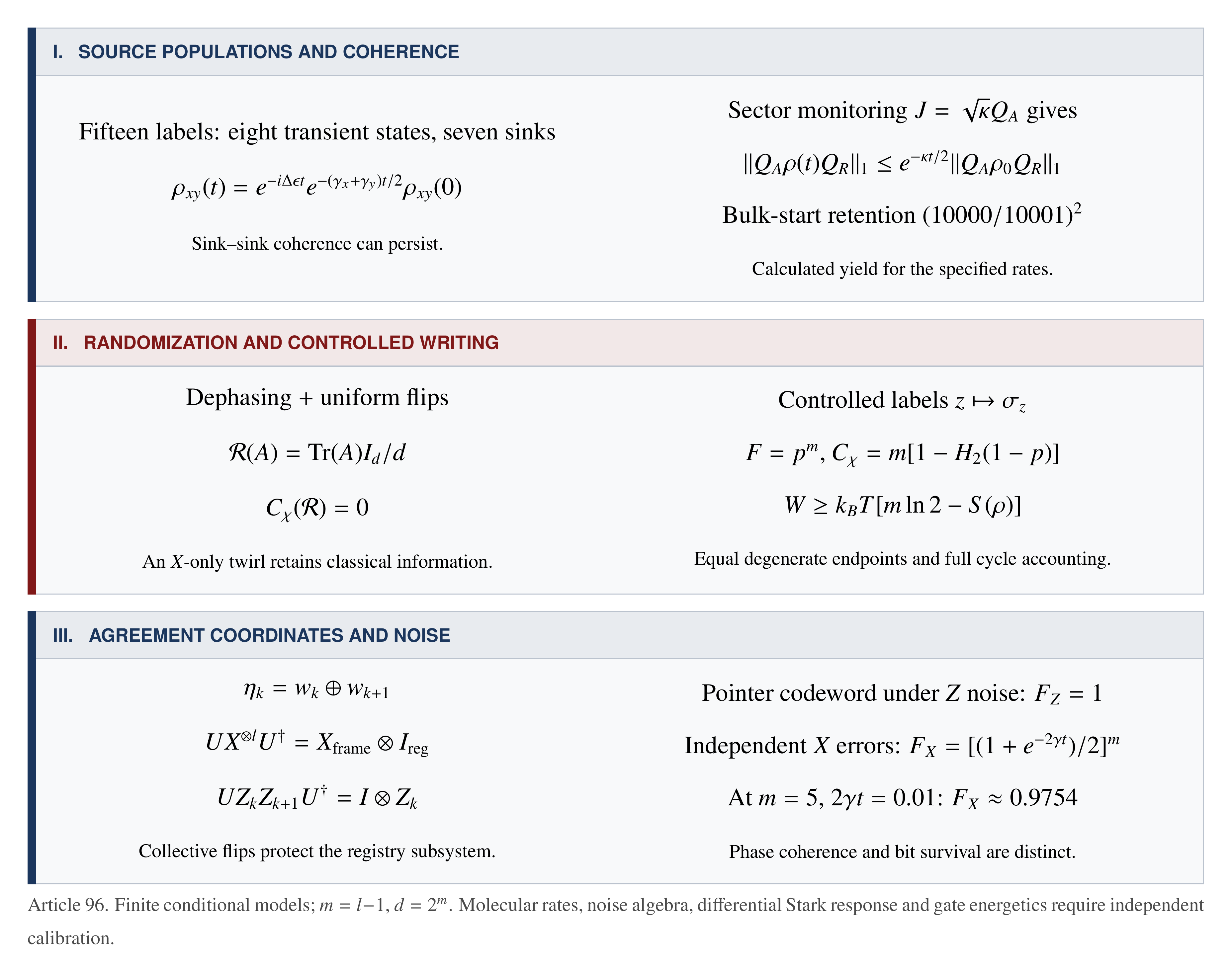
The endogenous source and the placed source are formulated as complementary finite quantum preparation models on a chemical-label space and a registry space of $l-1$ bits. A rank-one-jump Lindblad lift of an explicit fifteen-state reaction--transport network reproduces its classical populations and gives exact off-diagonal damping rates. We characterize the persistent coherence between absorbing sinks, prove scission when the initial cross-sink block vanishes, and obtain an all-state trace-norm bound after adding explicit sector monitoring. For the stated benchmark rates, bulk-start retention is $(10000/10001)^2$. Registry randomization is implemented by complete dephasing followed by uniform flips, equivalently the replacement channel $A\mapsto\operatorname{Tr}(A)I/2^{l-1}$; an $X$-only twirl retains classical information. The controlled family of independent-contact Gibbs states has fidelity $p^{l-1}$ and classical Holevo capacity $(l-1)[1-H_2(1-p)]$, whereas each fixed-target replacement channel has zero input capacity. Under equal degenerate endpoint Hamiltonians and complete isothermal resource accounting, preparation obeys $W\ge k_BT[(l-1)\ln2-S(\rho)]$. We derive the nonnegative bias threshold for a prescribed fidelity and separate it from the total preparation work. The unitary agreement transform makes the registry a noiseless subsystem under collective site flips; longitudinal phase noise instead preserves only its diagonal pointer algebra. An independent registry bit-flip model gives a distinct transit-survival formula. Finite verification and scoped Lean certificates support the algebraic construction, while calibrated rates, differential Stark response, bath correlations and gate-cycle energetics define the requirements for a molecular realization.
Downloads
Published
Issue
Section
License
Copyright (c) 2026 Charles D. Schaper, Ph.D.

This work is licensed under a Creative Commons Attribution-NonCommercial-NoDerivatives 4.0 International License.