Information-Theoretic Mechanics of Survival in Maximum-Entropy Environments Static Minimax Disturbance Attenuation, Coordination-Deficit Costs, and the Placed Source as Categorical Right Adjoint
DOI:
https://doi.org/10.68366/1k5vcj78Keywords:
Chrysene Formalism, survival in maximum entropy, H-infinity Control, coordination-deficit model, graph spectra, categorical adjunctionAbstract
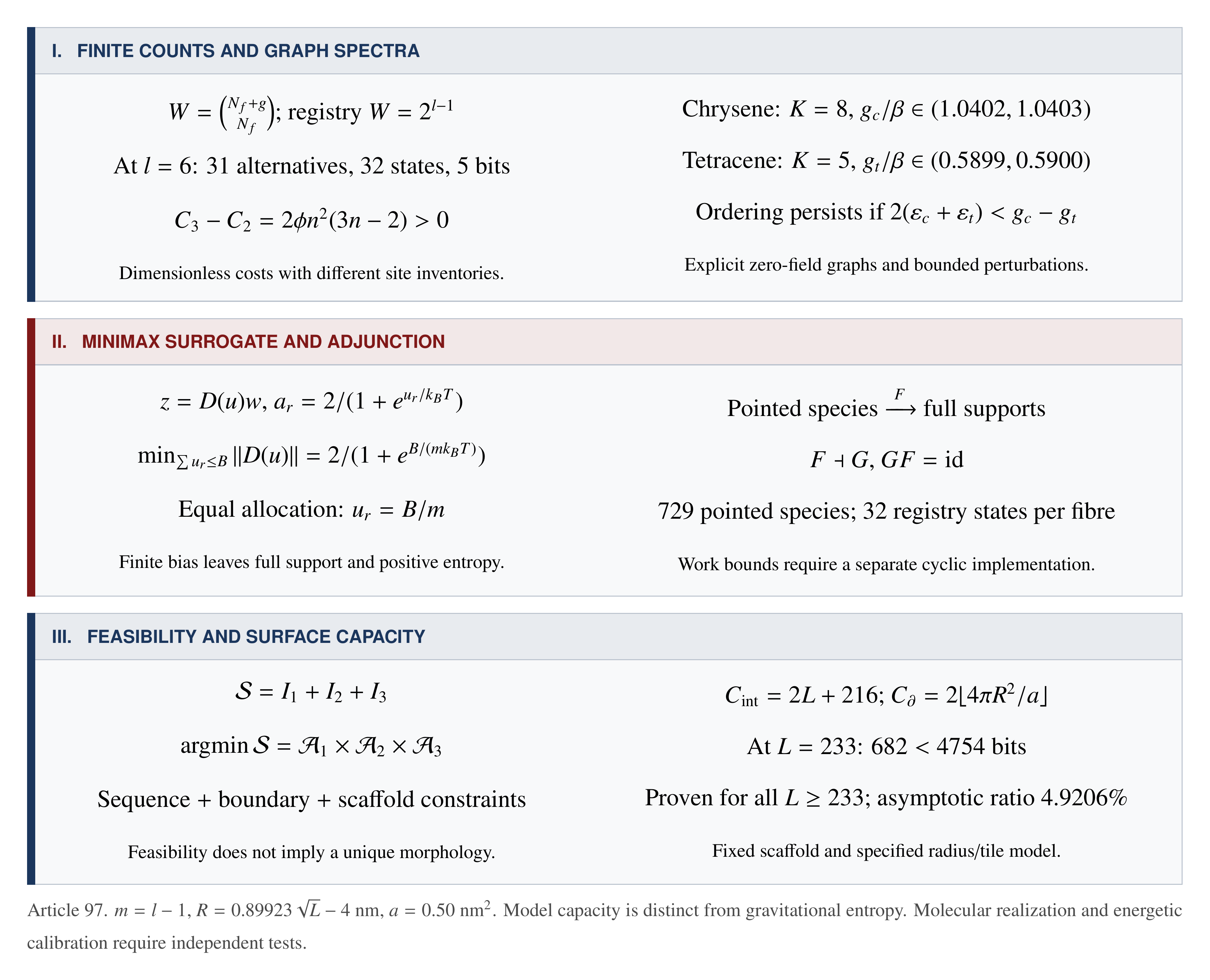
We formulate a finite coordination between endogenous supply and exogenous registry preparation in the substituted-chrysene framework. A binomial slack count identifies the uniform $l$-site registry with $2^{l-1}$ states, while a dimensionless coordination-deficit comparison distinguishes unequal-inventory lattice costs from a physical free-energy minimization. For two explicit 18-carbon graphs, perfect-matching counts and one-orbital spectra give a zero-field chrysene--tetracene gap comparison; a perturbation-norm condition supplies a sufficient bounded-field extension. Independent Gibbs contacts define the coefficients of an explicit static disturbance surrogate. Its induced $L^2$ gain is minimized by equal allocation of a fixed total energy-splitting budget. Finite bias leaves positive entropy and full registry support. A reverse-inclusion category of supports containing a chosen target admits a natural adjunction with the discrete category of pointed species words, with identity monad; thermodynamic work bounds require a separate cyclic isothermal implementation. A three-component indicator functional characterizes feasible sequence, boundary and scaffold configurations without asserting a unique morphology. Finally, under a specified radius law, fixed scaffold and quaternary boundary alphabet, we prove a surface-capacity inequality for every integer $L\ge233$ and derive its asymptotic utilization. At $L=233$, the model compares $682$ interior bits with $4{,}754$ boundary bits. The resulting capacity budget is distinct from a gravitational entropy bound. The mathematical results are accompanied by reproducible verification and explicitly scoped Lean certificates, with molecular realization expressed through experimentally testable conditions.
Downloads
Published
Issue
Section
License
Copyright (c) 2026 Charles D. Schaper, Ph.D.

This work is licensed under a Creative Commons Attribution-NonCommercial-NoDerivatives 4.0 International License.