Quaternary Coding Theory of the Biological Ledger over GF(4): Evaluation Codes, Plaquette Checks, and Conditional Syndrome Decoding
DOI:
https://doi.org/10.68366/3gzgzq36Keywords:
Chrysene Formalism, Quaternary codes, evaluation codes, tensor-product code, cubical homology, syndrome instrumentAbstract
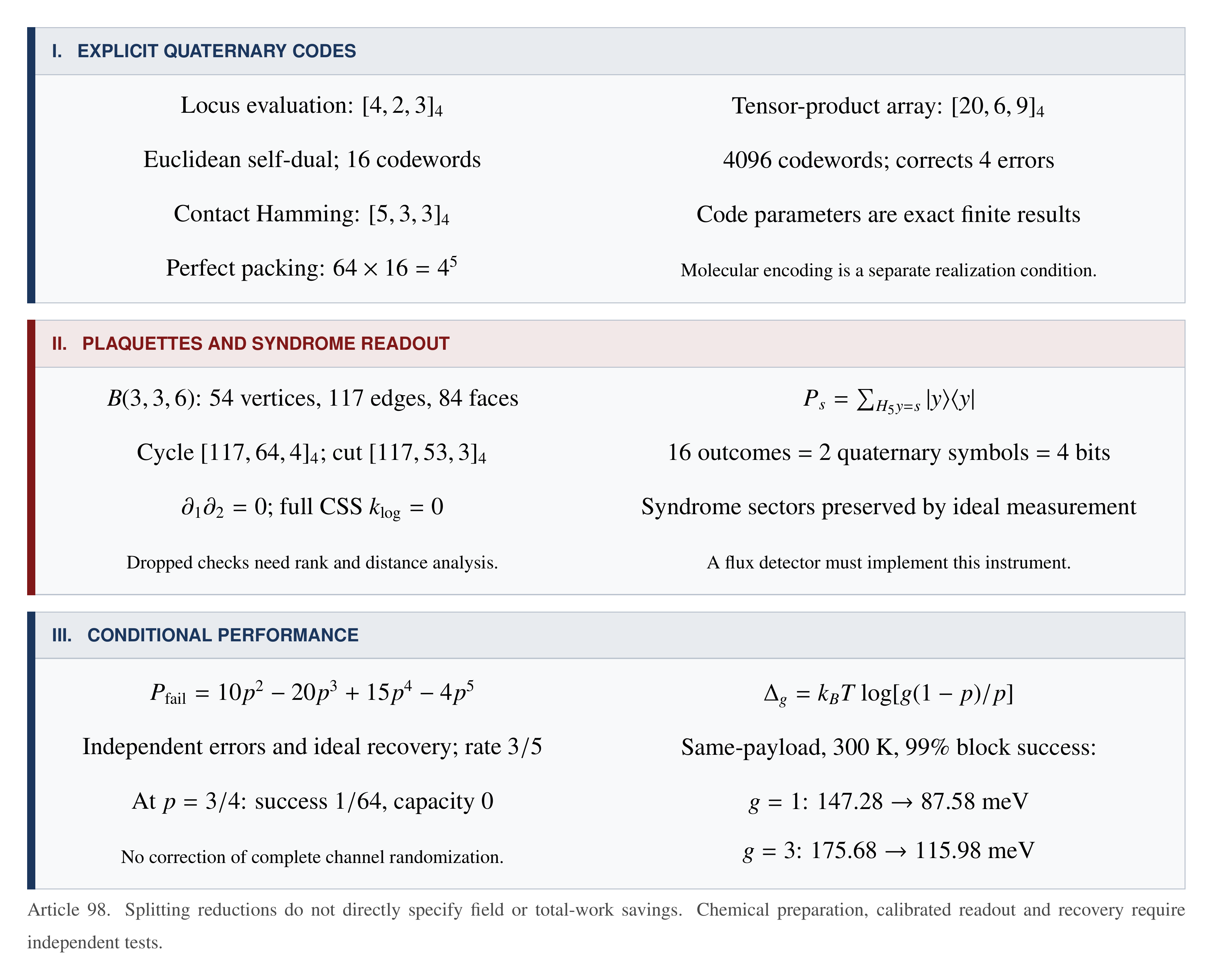
We construct explicit quaternary error-correcting codes for abstract locus, contact and lattice registers motivated by the Chrysene Formalism. Evaluation on the four affine points of $\mathrm{GF}(4)$ gives the Euclidean self-dual MDS code $[4,2,3]_4$. The five projective points give the perfect Hamming code $[5,3,3]_4$, whose 64 radius-one spheres partition $\mathrm{GF}(4)^5$; their tensor product is a $[20,6,9]_4$ array code correcting four arbitrary symbol errors. On the cubical box $B(3,3,6)$, the cycle and cut codes have parameters $[117,64,4]_4$ and $[117,53,3]_4$. Their full CSS check pair commutes and has zero logical dimension. An ideal 16-outcome syndrome instrument preserves each syndrome subspace and enables exact classical single-symbol correction. For independent symbol errors of probability $p$, decoded block failure is $10p^2-20p^3+15p^4-4p^5$. We compare uncoded blocks at both fixed coordinate count and equal information payload, distinguish binary-logistic and four-level Gibbs calibrations, and compute their conditional splitting thresholds. At complete quaternary randomization, $p=3/4$, channel capacity is zero and decoder success is only $1/64$. Molecular encoders, Berry-phase readout and Stark control are explicit realization targets rather than consequences of code cardinalities. Executable finite verification and a scoped Lean companion accompany the constructions.
Downloads
Published
Issue
Section
License
Copyright (c) 2026 Charles D. Schaper, Ph.D.

This work is licensed under a Creative Commons Attribution-NonCommercial-NoDerivatives 4.0 International License.