Endogenous and Exogenous Sources of Encoded Chrysene Systems: Functional Selection, Adaptive Realization, and Engineered Emulation
DOI:
https://doi.org/10.68366/sq2zf173Keywords:
Chrysene Formalism, molecular self-assembly, endogenous source, exogenous source, conditional selection, relative entropyAbstract
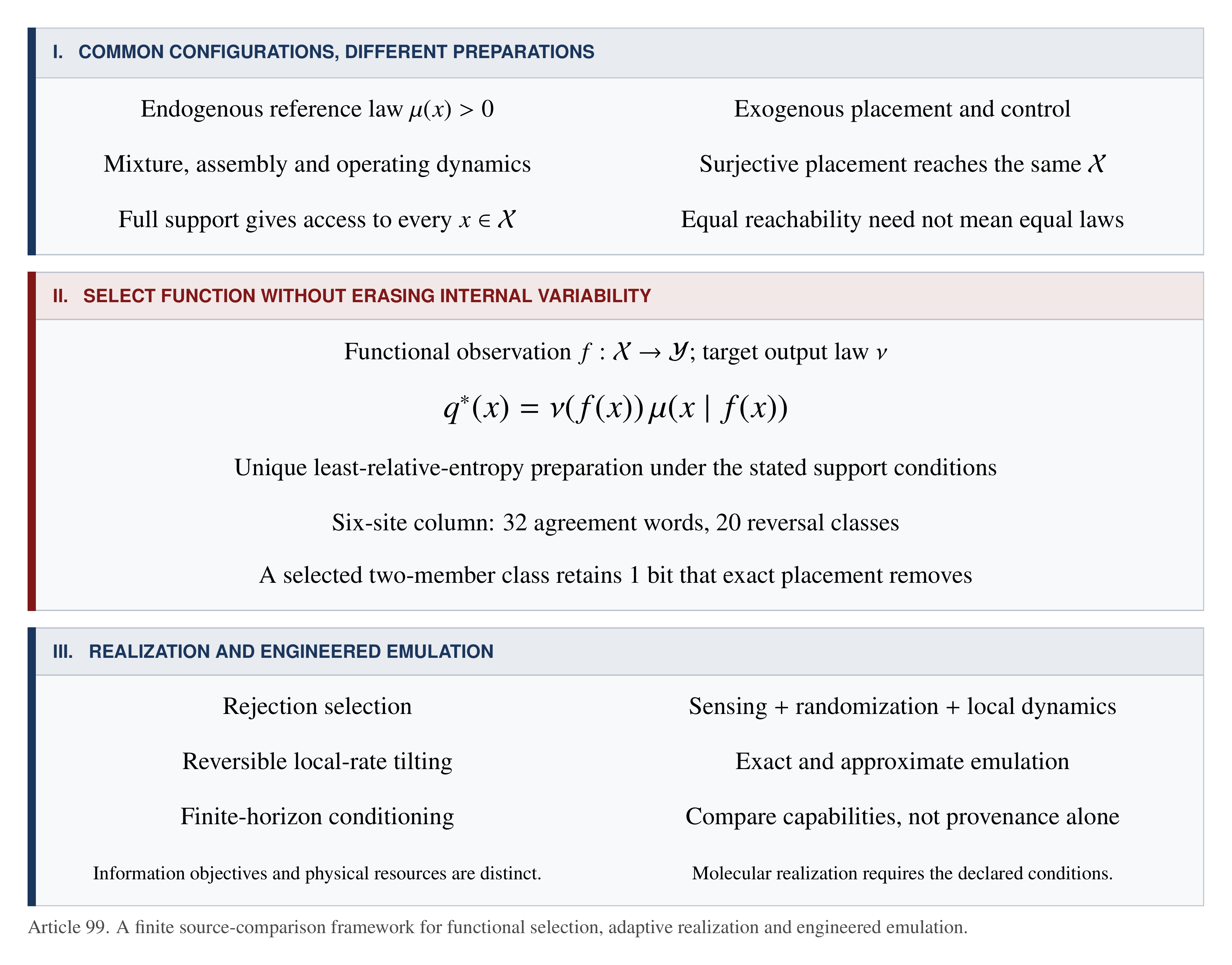
The genetic-code, protocell-ledger, and finite interior-lattice constructions of the Chrysene Formalism require a source of substituted molecular units and their organized assemblies. This fourth pilot study places endogenous assembly from a mixture and exogenous engineered preparation in a common finite mathematical framework. A source is represented by its admissible configurations, observable functions, preparation law, causal controls, and operating dynamics. Under full-support and placement hypotheses the two origins have the same reachable configurations, while their attainable distributions and trajectories can differ.
The principal comparison is functional rather than microscopic. For a positive endogenous reference law and a prescribed distribution of functional outputs, we derive the unique least-relative-entropy preparation: it changes the output distribution and preserves the reference conditional law within each functional fiber. Exact microscopic placement incurs an additional conditional information cost whenever the fiber is nontrivial. On a six-site registry column, the thirty-two agreement words give twenty reversal classes; selecting a two-member class retains one bit of variability that exact placement removes. We construct rejection, reversible local-rate, and finite-horizon conditioned realizations and distinguish their information objectives from their material and temporal requirements.
Robust-demand and responsive-kinetic examples give strict advantages over specified fixed-placement classes. Exact and approximate emulation theorems identify the sensing, randomization, local dynamics, and resource conditions by which an engineered source matches or approaches those capabilities. A coefficient-consistent lattice extension separates structural invariants from source-dependent laws. The resulting theory compares endogenous and exogenous organization without making molecular provenance itself an obstruction to engineering.
Downloads
Published
Issue
Section
License
Copyright (c) 2026 Charles D. Schaper, Ph.D.

This work is licensed under a Creative Commons Attribution-NonCommercial-NoDerivatives 4.0 International License.