Symmetry-Compatible Information in the Chrysene Formalism: Axiomatic Realization, Coding Obstructions, Constructive Repair, and Falsifiable Molecular Models
DOI:
https://doi.org/10.68366/cf4tjz97Keywords:
Chrysene Formalism, equivariant decoding, quaternary code, molecular symmetry, biogenesis, formal verificationAbstract
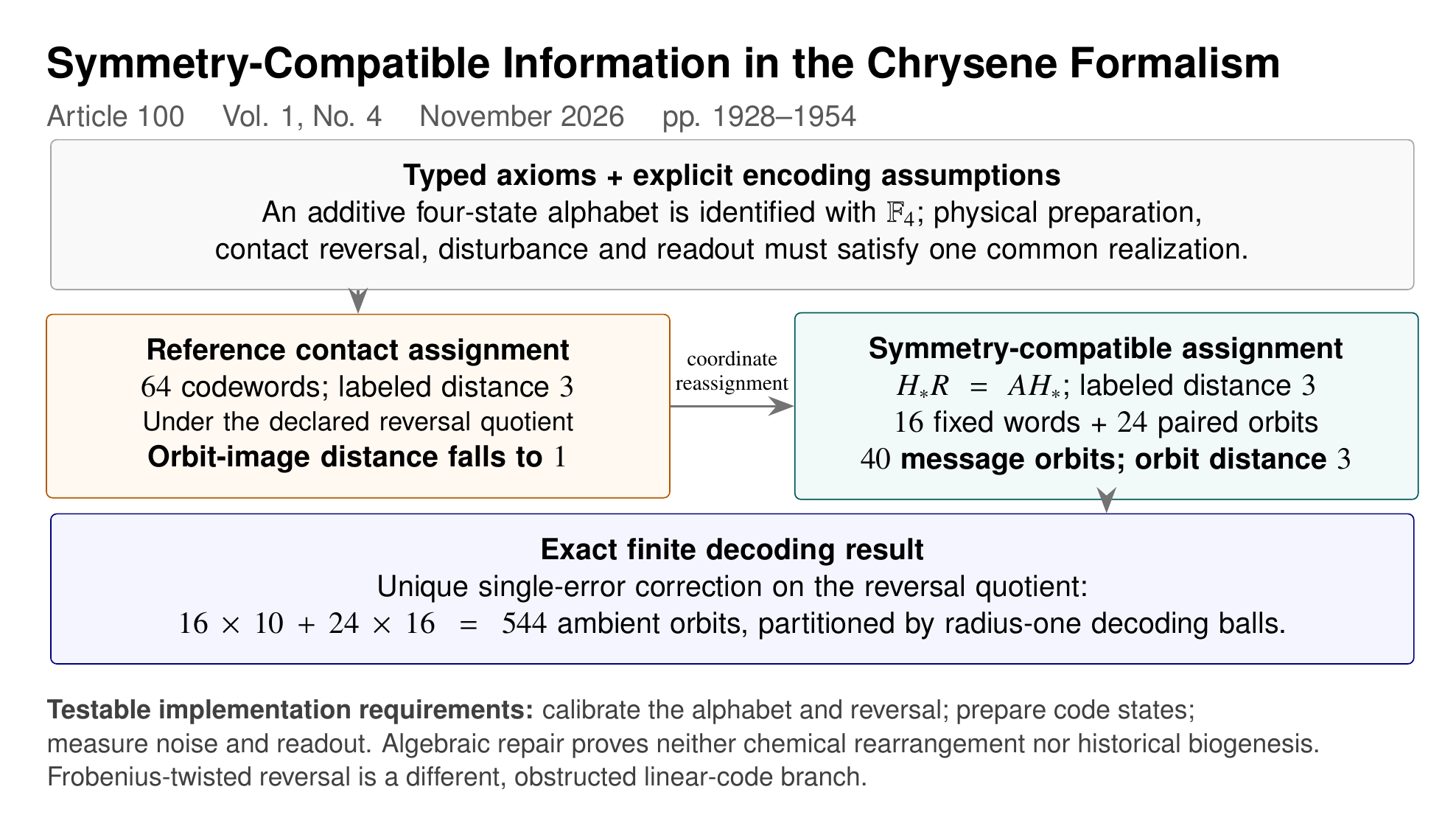
The Chrysene Formalism organizes molecular structure, assembly, information, and operator response through a typed axiomatic framework. We develop a compatibility theorem for information architectures whose states are identified by a structural symmetry. An invariant code with unique bounded-distance decoding induces a unique decoder on the orbit space; the corresponding statement may fail if an incompatible code is first closed under the symmetry. On a five-contact quaternary model for an open six-unit carrier, an explicit [5,3,3] over GF(4) Hamming code loses single-error correction under naive reversal closure. A coordinate-equivalent code satisfies a syndrome covariance identity, has sixteen reversal-fixed words and forty codeword orbits, and gives perfect radius-one decoding on all 544 ambient orbits. In contrast, reversal composed with Frobenius is incompatible with every linear code of these parameters: the induced permutation on the projective line would have both even and odd parity. These finite results are connected to the twelve-axiom framework by explicit alphabet, state-preparation, symmetry-action, disturbance, and readout hypotheses. We derive conditional implementation and robust failure bounds, finite feasibility certificates, and comparative tests for molecular realization. The resulting research program combines deterministic mathematical constraints with stochastic preparation and measured physical response. We place this contribution within the journal's mathematical, biogenesis, molecular-machine, and abstract-application programs, with versioned verification and AI-augmented human review. Exact finite checks and a scoped Lean 4 companion accompany the manuscript; physical realization and historical attribution remain empirical questions.
Downloads
Published
Issue
Section
License
Copyright (c) 2026 Charles D. Schaper, Ph.D.

This work is licensed under a Creative Commons Attribution-NonCommercial-NoDerivatives 4.0 International License.