Skip to main content Skip to main navigation menu Skip to site footer
Annals of the Chrysene Formalism
  • Current
  • Archives
  • About
    • About the Journal
    • Submissions
    • Editorial Masthead
    • Privacy Statement
    • Contact
    • Press / Media Contact
Search
  • Register
  • Login
  1. Home /
  2. Archives /
  3. Vol. 1 No. 5 (2026)

Vol. 1 No. 5 (2026)

Published: 2026-11-16

Original Research (Research Articles)

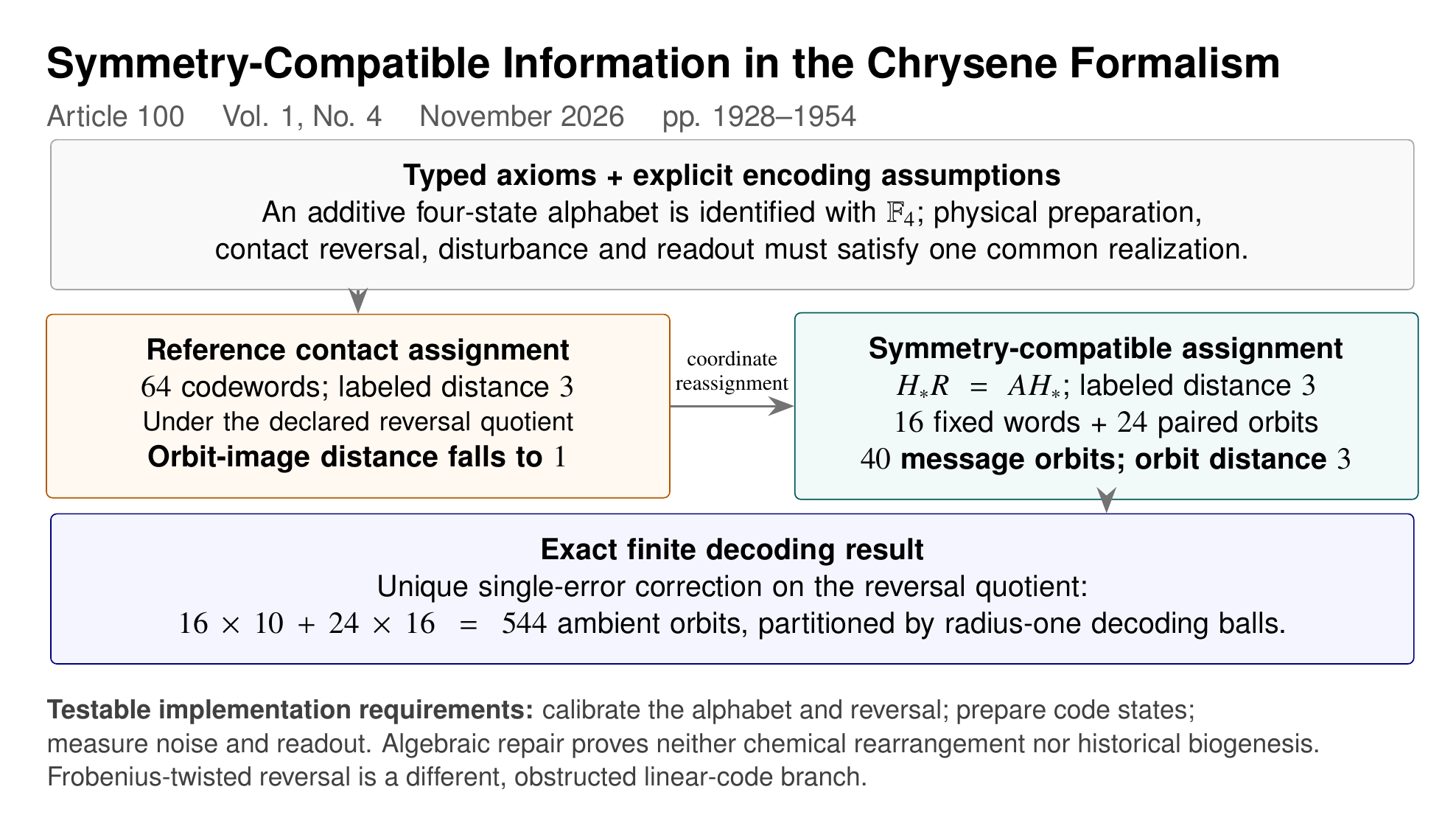
  • A top box lists typed axioms and explicit encoding assumptions. An orange left box shows a reference code with 64 words and labeled distance three but orbit-image distance one. A horizontal arrow marked coordinate reassignment leads to a teal box showing the compatible matrix identity, 16 fixed words plus 24 paired orbits, and orbit distance three. A lower blue box states that sixteen quotient decoding balls of size ten and twenty-four of size sixteen partition 544 ambient orbits. A bottom note distinguishes algebraic repair from chemical or historical evidence and distinguishes Frobenius-twisted reversal.

    Symmetry-Compatible Information in the Chrysene Formalism: Axiomatic Realization, Coding Obstructions, Constructive Repair, and Falsifiable Molecular Models

    Charles D. Schaper, Ph.D.
    1928-1954
    • PDF
    • REVIEW HISTORY
    • VERIFICATION CODE
    • FORMAL PROOF
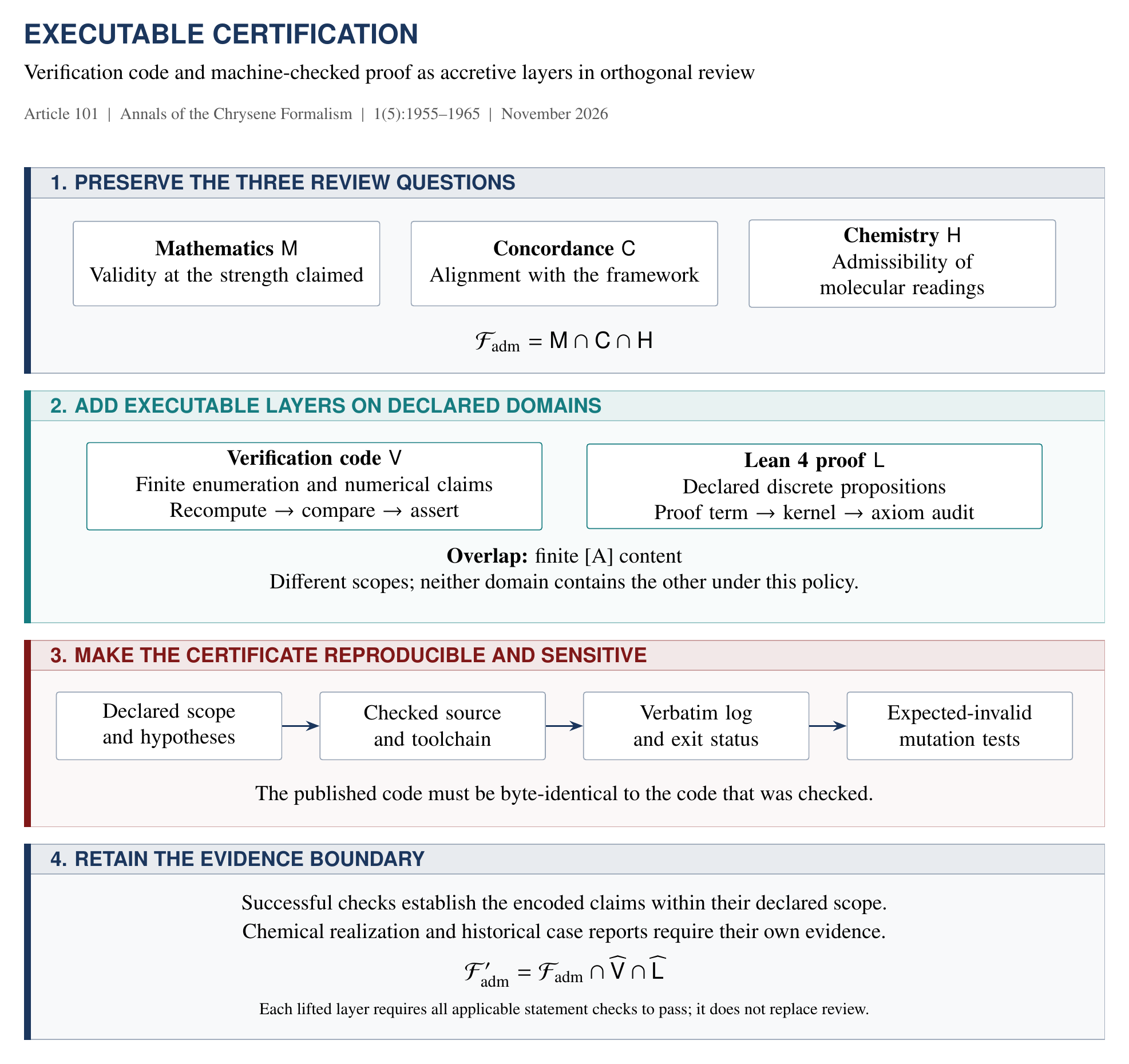
  • Four-tier workflow. The top tier retains Mathematics, Concordance, and Chemistry review. The second adds two parallel layers: verification code for finite enumeration and numerical claims, and Lean 4 proof for declared discrete propositions. Their shared scope is finite [A] content; neither domain contains the other under the stated policy. The third tier links declared scope, checked source and toolchain, verbatim logs and exit status, and expected-invalid mutation tests; the published source must match the checked source byte for byte. The bottom tier combines all applicable checks with the original review conditions and separates encoded results from chemical realization and historical evidence.

    Executable Certification: Verification Code and Machine-Checked Proof as Accretive Layers in Orthogonal Review

    Charles D. Schaper, Ph.D.
    1955-1965
    • PDF
    • REVIEW HISTORY
    • VERIFICATION CODE
    • FORMAL PROOF
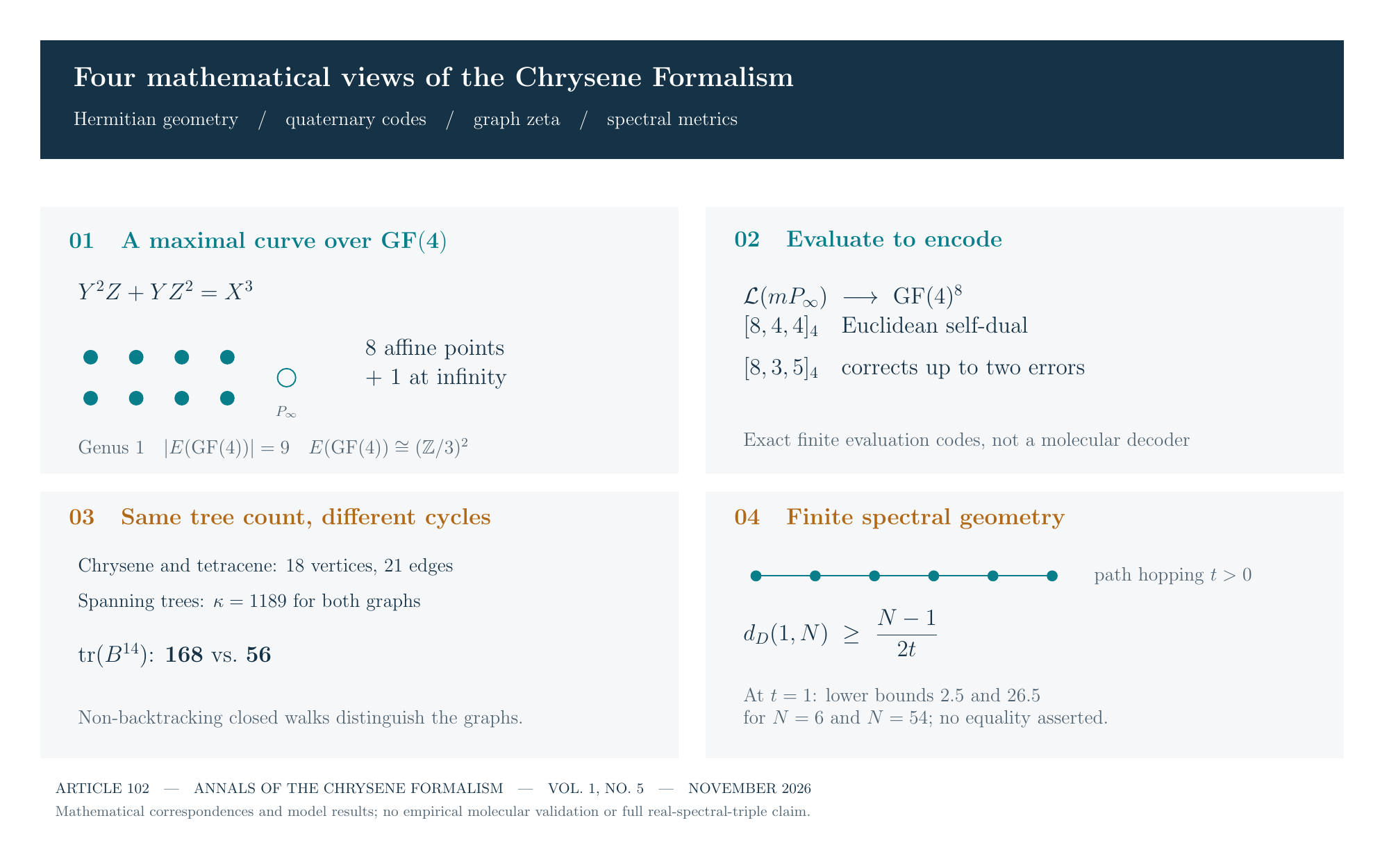
  • Four-panel graphical abstract for Article 102. Panel 1 shows the genus-one Hermitian curve Y^2 Z + Y Z^2 = X^3 over GF(4), represented by eight filled dots for its affine rational points and an open dot for the point at infinity. Its nine rational points form the group (Z/3)^2. Panel 2 shows evaluation on the eight affine points producing a Euclidean self-dual [8,4,4] quaternary code and a [8,3,5] quaternary code that corrects up to two errors. Panel 3 compares the 18-vertex, 21-edge chrysene and tetracene graphs: both have 1189 spanning trees, but their length-14 non-backtracking closed-walk traces are 168 and 56. Panel 4 depicts a nearest-neighbor hopping path with positive hopping strength t and the spectral-distance lower bound (N-1)/(2t), giving 2.5 and 26.5 for N=6 and N=54 when t=1. The footer states that these are mathematical correspondences and model results, not empirical molecular validation or a claim to a full real spectral triple.

    Arithmetic Geometry, Spectral Zeta Theory, and Non-Commutative Geometry of the Chrysene Formalism: The (9, 8) Hermitian Curve over GF(4), Genus-1 Goppa Codes, the Ihara–Bass Zeta Function, and Connes’ Spectral Triple

    Charles D. Schaper, Ph.D.
    1966-1974
    • PDF
    • REVIEW HISTORY
    • VERIFICATION CODE
    • FORMAL PROOF
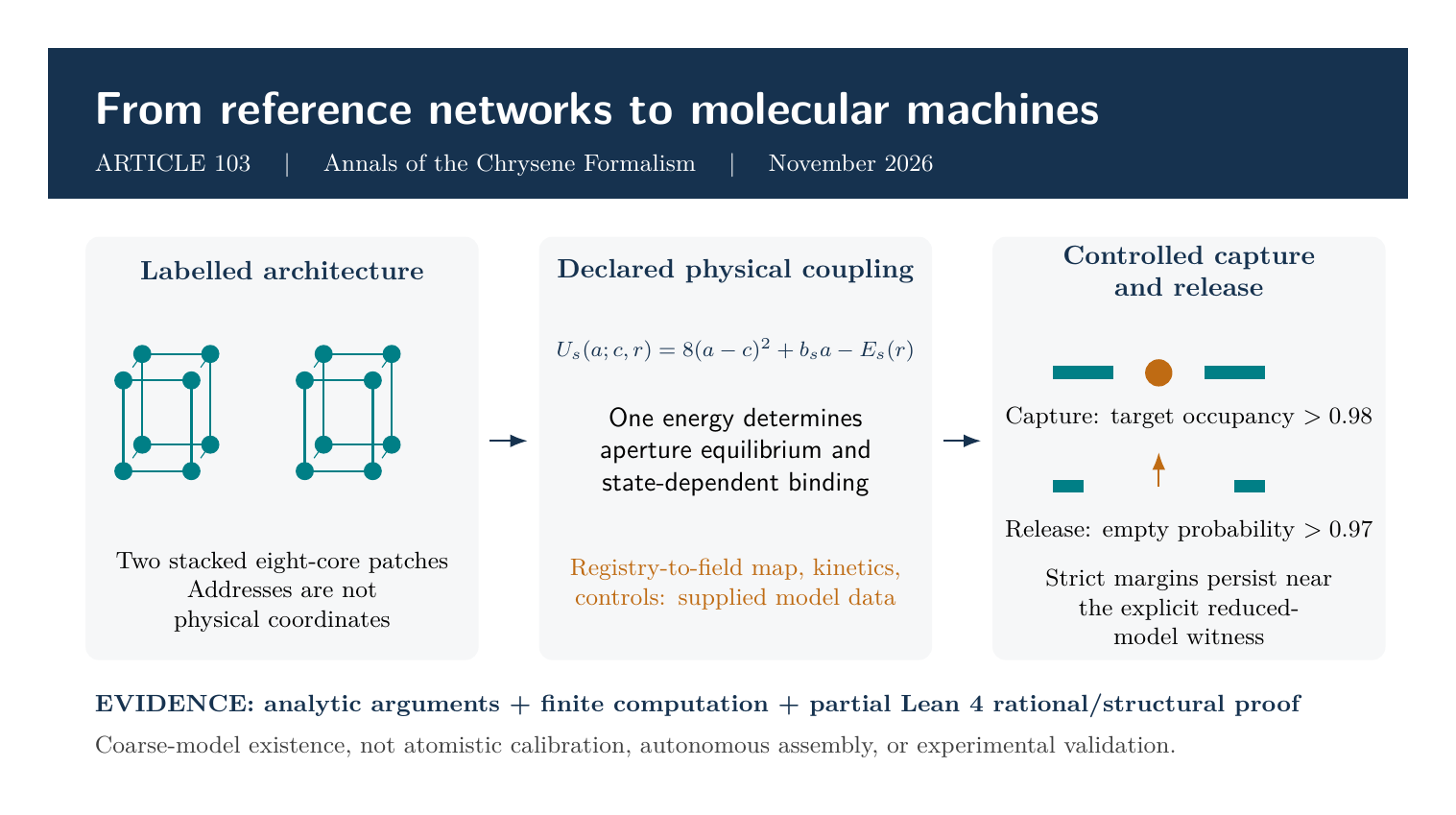
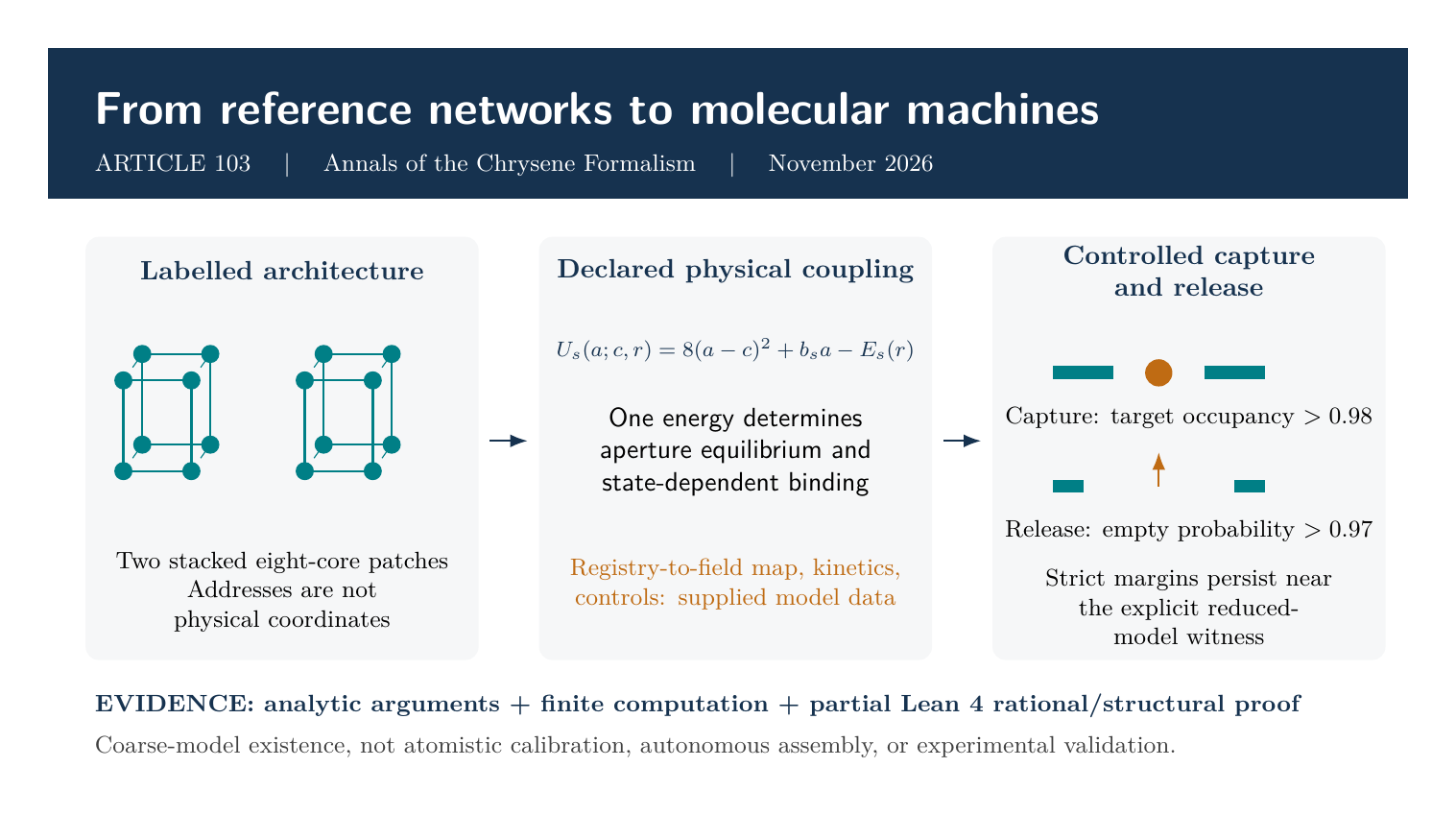
  • Three-panel graphical abstract. The first panel depicts a labelled stacked network and identifies a mechanical witness comprising two eight-core patches, distinguishing integer addresses from physical coordinates. The middle panel gives the common reduced energy U_s(a;c,r) = 8(a-c)^2 + b_s a - E_s(r), which determines aperture equilibrium and state-dependent binding. Registry-to-field coupling, kinetics, and controls are declared model data. The third panel shows controlled capture with target occupancy greater than 0.98 and release with empty-site probability greater than 0.97. Strict margins persist near the explicit witness. Evidence combines analytic arguments, finite computation, and a partial Lean 4 structural and rational formalization. This is coarse-model existence, not atomistic calibration, autonomous assembly, or experimental validation.

    From Fibrated Chrysene Networks to Molecular Machines: Registry-Programmed Geometry, Electromechanical Realization, and Constructive Existence

    Charles D. Schaper, Ph.D.
    1975-1990
    • PDF
    • REVIEW HISTORY
    • VERIFICATION CODE
    • FORMAL PROOF
  • Schematic of the minimal abiotic loom in Article 104. An intact 4 by 2 by 2 substituted-chrysene reference with sixteen nodes and exterior workstations receives a prepared glycine/alanine packet pool. Registry program GAGA selects four packets. Three atom-conserving graph joins produce the GAGA peptide graph and three labelled water graphs; an external symbolic record tracks the actual incorporated sequence. Under the stipulated competing-channel law, the correct first-output probability exceeds 0.94 and number/probability-fraction target purity among all collected chains exceeds 0.97. Delivery to a reduced receiver gives target-occupancy contrasts greater than 0.83 against absent product and greater than 0.09 against GGGA. The graphic depicts a constructive finite-model existence result, not experimentally demonstrated peptide synthesis.

    From Registry-Controlled Capture to Productive Molecular Assembly: Constructive Existence of a Minimal Abiotic Loom

    Charles D. Schaper, Ph.D.
    1991-2007
    • PDF
    • REVIEW HISTORY
    • VERIFICATION CODE
    • FORMAL PROOF

© 2026 Schaper Biosciences Corporation. All rights reserved.

Published by Schaper Systems Press, a division of Schaper Biosciences Corporation · San Francisco, California, USA

ISSN: 3144-2021  |  Ringgold ID: 857561  |  ISNI: 0000 0005 3177 8859  |  DOI Prefix: 10.68366

Editorial & Media Inquiries: editor@chrysene.com  |  Press & Media Contact

More information about the publishing system, Platform and Workflow by OJS/PKP.