Arithmetic Geometry, Spectral Zeta Theory, and Non-Commutative Geometry of the Chrysene Formalism: The (9, 8) Hermitian Curve over GF(4), Genus-1 Goppa Codes, the Ihara–Bass Zeta Function, and Connes’ Spectral Triple
DOI:
https://doi.org/10.68366/0fzbpd91Keywords:
Chrysene Formalism, Hermitian curve over GF(4), algebraic-geometric codes, Euclidean self-duality, Ihara-Bass zeta function, finite spectral geometryAbstract
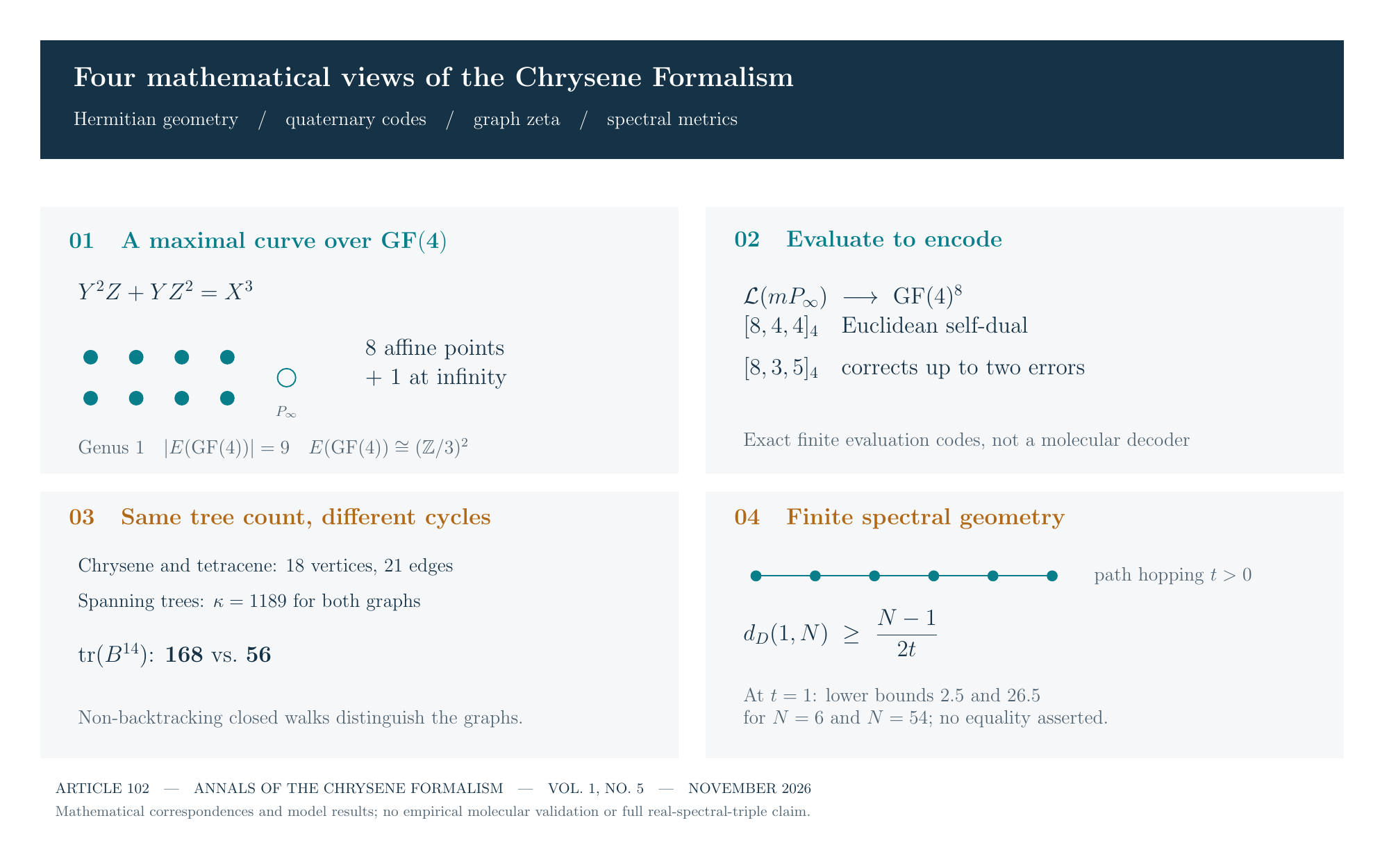
This paper develops four mathematical constructions associated with finite graph and quaternary structures in the Chrysene Formalism. The smooth projective Hermitian curve Y^2 Z + Y Z^2 = X^3 over GF(4) has genus one and attains the Hasse-Weil bound with nine rational points: eight affine points and one point at infinity. Its rational-point group is (Z/3)^2. The numerical correspondence with the two nine-vertex parts and eight perfect matchings of the chrysene graph is distinguished from a canonical structural identification. Evaluation of the Riemann-Roch spaces L(4P_infinity) and L(3P_infinity) on the eight affine points gives, respectively, a Euclidean self-dual [8,4,4] quaternary code and a [8,3,5] quaternary code correcting up to two errors. Exact computations for the supplied chrysene and tetracene graph models establish that both each have 1189 spanning trees and Ihara-Bass derivative +7134 at one, while their degree-shift invariants, three-matching counts, adjacency characteristic coefficients, and non-backtracking closed-walk counts distinguish them. In particular, the length-14 non-backtracking traces are 168 and 56. Finite even spectral data are separated from the stronger real-spectral-triple requirements: the natural inversion exchanges the bipartition, and the full diagonal algebra fails the order-one condition for adjacency hopping. For a path with nearest-neighbor hopping strength t, an explicit admissible observable gives the spectral-distance lower bound (N-1)/(2t), without asserting equality. At t=1 this yields 2.5 and 26.5 for paths of lengths six and fifty-four vertices. These results are mathematical constructions and conditional model interpretations, not empirical validation of molecular coding, transport, or biogenesis.
Downloads
Published
Issue
Section
License
Copyright (c) 2026 Charles D. Schaper, Ph.D.

This work is licensed under a Creative Commons Attribution-NonCommercial-NoDerivatives 4.0 International License.