From Fibrated Chrysene Networks to Molecular Machines: Registry-Programmed Geometry, Electromechanical Realization, and Constructive Existence
DOI:
https://doi.org/10.68366/sc7jgw45Keywords:
Chrysene Formalism, fibrated network, molecular machine, programmable metamaterial, registry, constrained mechanicsAbstract
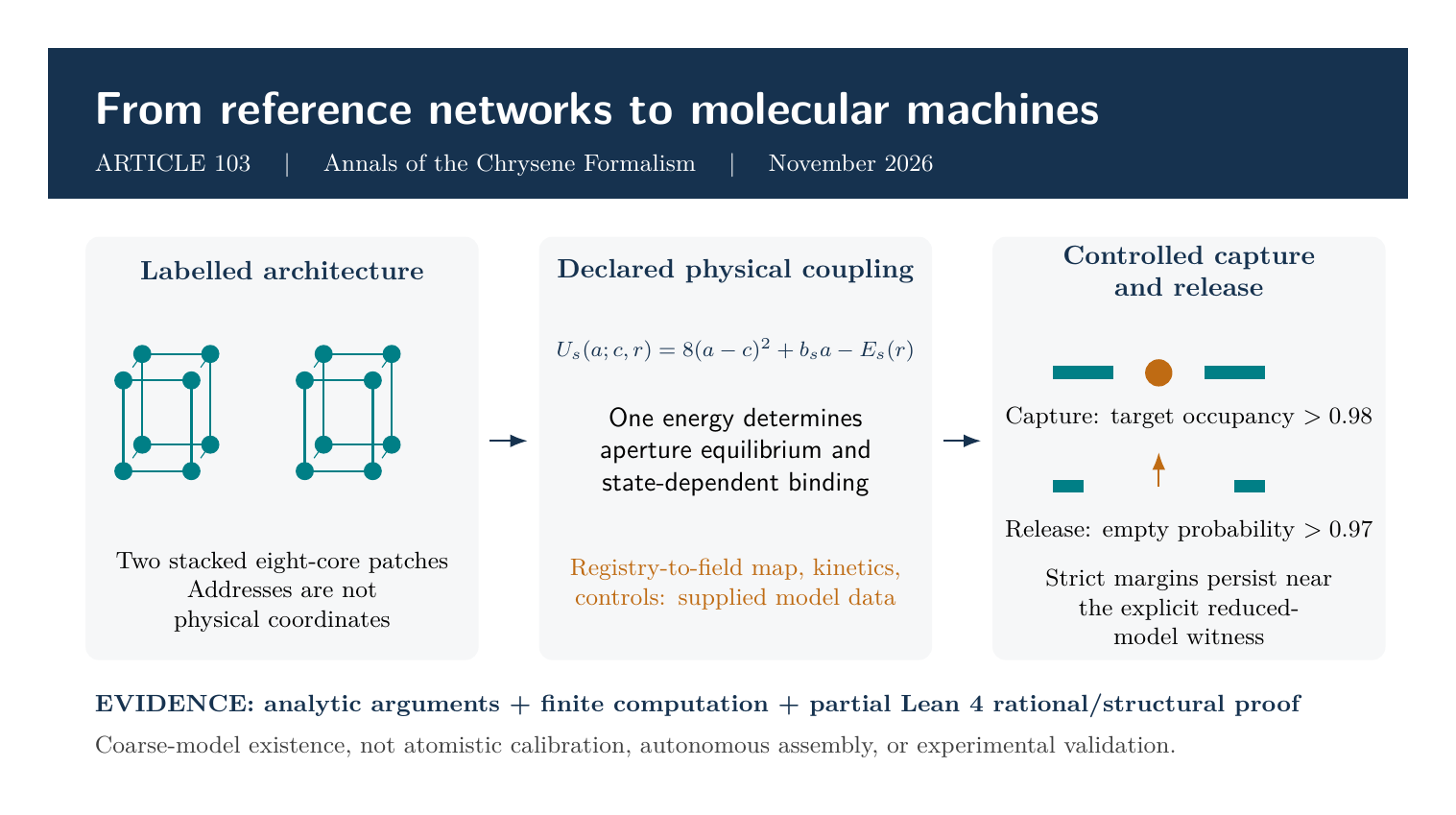
The fibrated architecture of the Chrysene Formalism provides a labelled reference network with substituent-mediated lateral connections and a distinct interlayer stacking relation. We extend a finite portion of that architecture into a registry-dependent mechanical system by assigning molecular positions, orientations, compliant connector coordinates, interaction energies, and admissible transitions. The integer address, physical configuration, local structural tensor, and numerical mesh are kept distinct. General results establish constrained equilibrium existence, local stable branches, controlled dissipation, symmetry obstructions, and compatibility of finite executions.
A constructive reduced realization consists of two eight-core stacked patches joined through a compliant aperture. One common energy yields its equilibrium aperture and its state-dependent binding levels. A declared electrostatic registry coupling produces target discrimination; a controlled aperture change produces capture and release. An explicit parameter choice has target occupancy greater than 0.98 in the capture setting and empty-site probability greater than 0.97 in the release setting. These strict inequalities, the geometric clearance, and the positive reduced stiffness persist in a neighborhood of the model parameters. Reversible binding kinetics and a mechanical relaxation law complete the finite operational model without identifying equilibrium motion with directed work.
We then define compatible interfaces for coupled code–product formation and structure-filtered peptide selection, prove a finite coding-lift result and a selection leakage bound, and organize hinges, gates, sliders, pockets, rotors, and helicase-like assemblies into an atlas of proof obligations. A posteriori mechanical bounds distinguish numerical verification from continuum homogenization. The existence result concerns an explicitly specified coarse molecular model; molecular calibration, reaction chemistry, and autonomous assembly constitute further realization problems.
Downloads
Published
Issue
Section
License
Copyright (c) 2026 Charles D. Schaper, Ph.D.

This work is licensed under a Creative Commons Attribution-NonCommercial-NoDerivatives 4.0 International License.