From Registry-Controlled Capture to Productive Molecular Assembly: Constructive Existence of a Minimal Abiotic Loom
DOI:
https://doi.org/10.68366/581cxd24Keywords:
Chrysene Formalism, Abiotic Loom, productive molecular assembly, registry, peptide graph, atom-origin ledger, constructive existenceAbstract
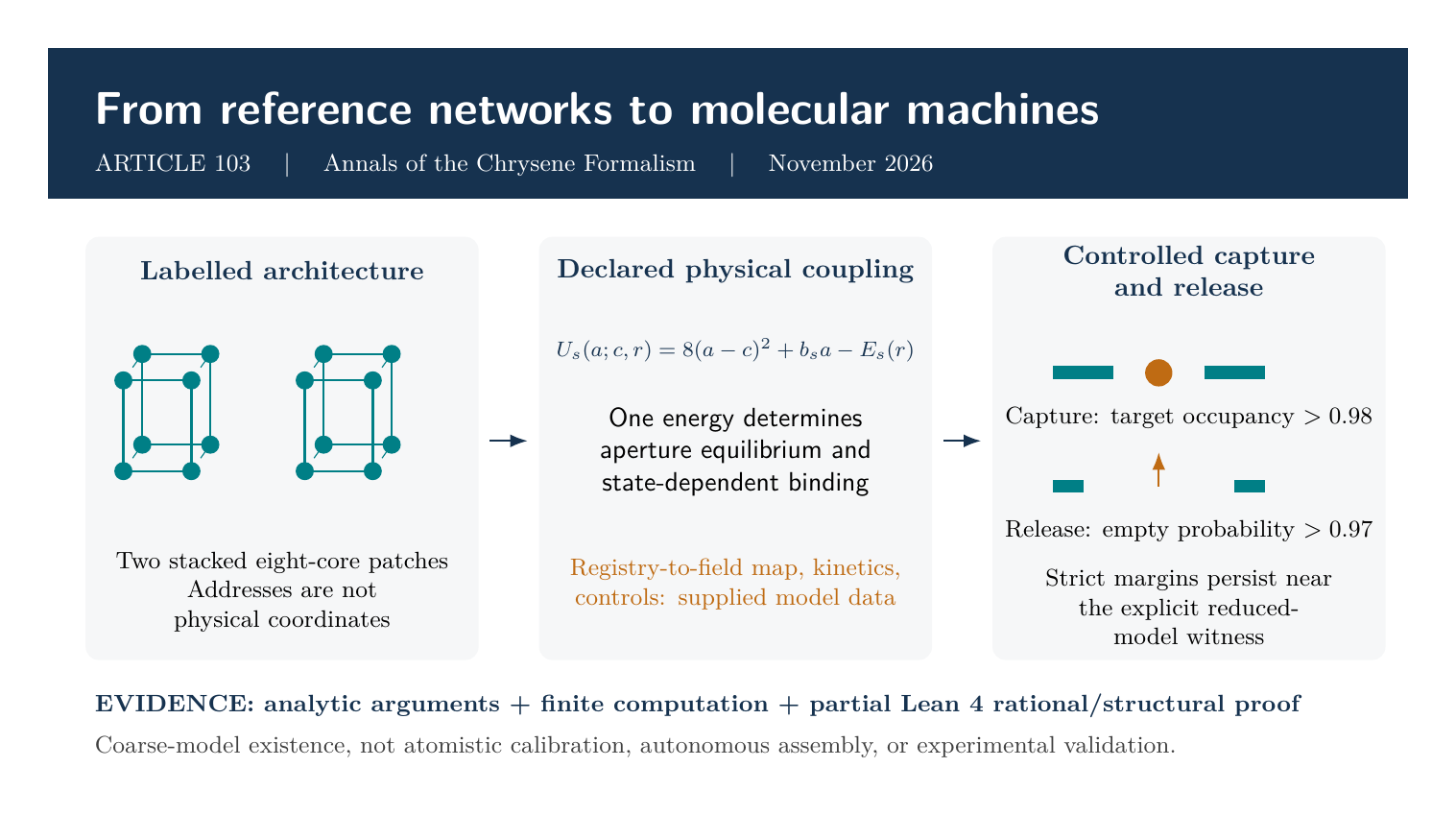
We extend registry-controlled substrate handling to productive assembly on an intact finite substituted-chrysene reference. The framework contains every prescribed node and connection and uses exterior workstations, without defect-generated cavities or ionic or nucleobase insertions. A common state carries the framework, prepared molecular graphs, fresh-resource accounts, product prefixes, external symbolic records, controls, and receiver states. Composition, stable-branch, clearance, and finite-state absorption results separate geometric feasibility from executable transformation and productive output from equilibrium occupancy.
An explicit reduced witness selects a nonhomogeneous four-residue word from a common glycine/alanine input pool. Three valence-preserving graph joins produce GAGA and three labelled waters while preserving all atom origins. A declared competing-channel law gives correct first-output probability 125000/132651 > 0.94 and target purity 250000/257651 > 0.97 among all collected chains, including shorter incorrect outputs. A common neutral product–receiver energy yields a stable target-occupancy contrast greater than 0.83 against the absent-product condition and greater than 0.09 against the single-position intervention GGGA. These inequalities have exact arithmetic certificates and persist under specified admissible perturbations. Reversible receiver kinetics gives a finite-time readout, while loading, delivery, and chemical realization retain explicit interfaces.
The existence theorem concerns one fully specified finite graph, envelope, kinetic, and interaction model. Actual amide synthesis, constitutive calibration, and nucleic-acid writing require additional molecular certificates; they are not inferred from graph admissibility or symbolic encoding. The construction supplies a bounded productive interface for subsequent work on repeatable operation and feedback, without invoking broad folding architectures or autonomous peptide clamps.
Downloads
Published
Issue
Section
License
Copyright (c) 2026 Charles D. Schaper, Ph.D.

This work is licensed under a Creative Commons Attribution-NonCommercial-NoDerivatives 4.0 International License.